


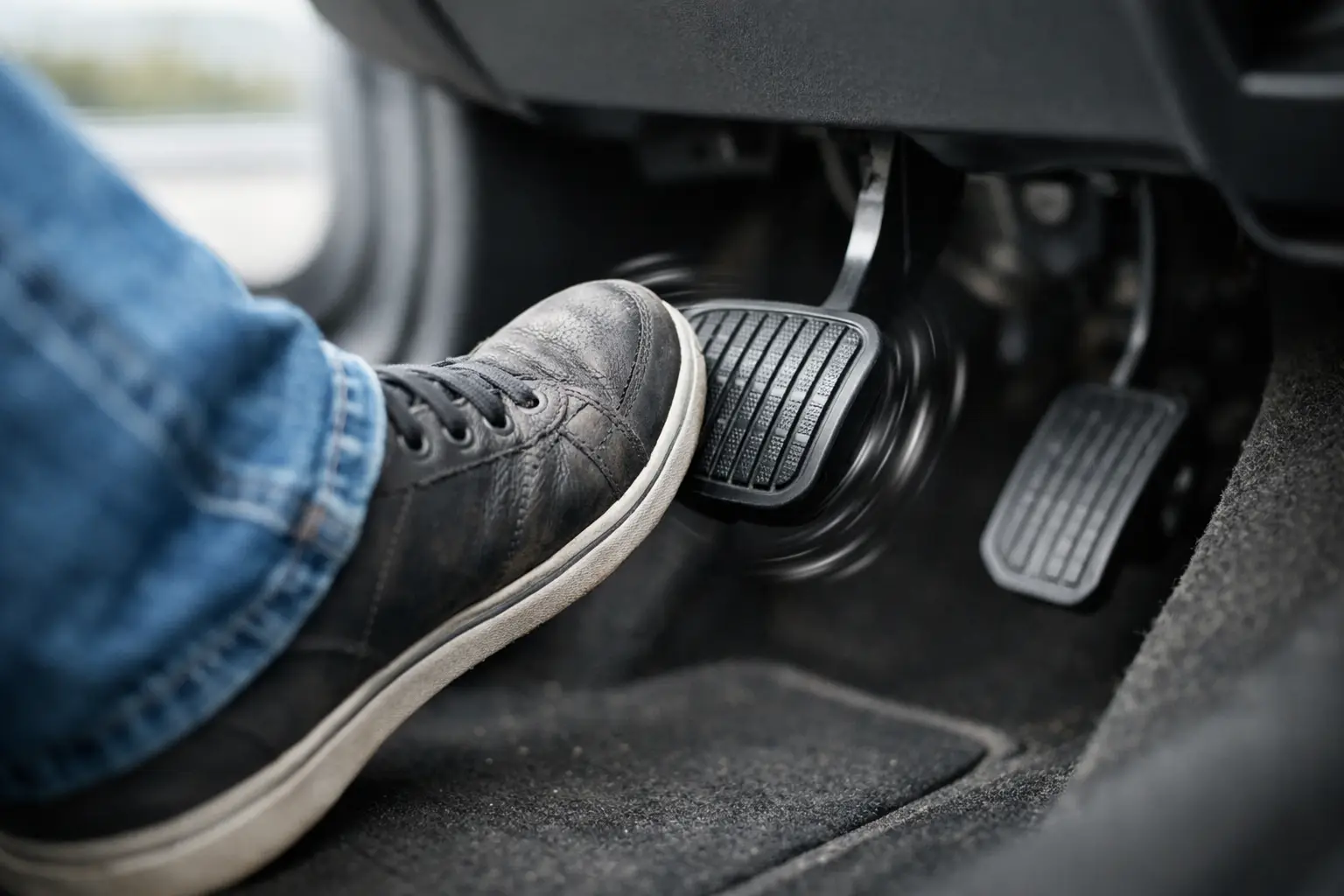
What Causes Brake Pedal Pulsation While Driving?
A brake pedal that pushes back against your foot is not a normal characteristic of an aging car. It is a warning that a rotating brake or wheel-end component may no longer be running true. If you are asking what causes brake pedal pulsation, the answer is usually related to brake disc runout, uneven disc thickness, or a fault that prevents the brake assembly from operating evenly.
The sensation may appear only during firm braking from highway speeds, or it may be noticeable even in slow traffic. Some drivers feel a repeated pulse through the pedal. Others notice steering wheel shake, a vibration through the floor, or a vehicle that feels unsettled under braking. The symptoms matter because they help a workshop identify whether the problem is at the front brakes, rear brakes, wheel hubs, suspension, or another system.
Brake pedal pulsation happens when the brake pads do not apply smooth, even pressure to a consistently flat rotating surface. In most passenger vehicles, that surface is the brake disc, also called a rotor. As the wheel turns, variations in the disc or its mounting surface repeatedly push the pads and caliper pistons back and forth. That movement travels through the hydraulic system and reaches the brake pedal.
Many people describe this as “warped rotors.” A severely overheated disc can distort, but the more common issue is disc thickness variation. This means the disc has developed slightly thicker and thinner areas around its braking surface. Even a small variation can be felt through the pedal at speed.
The underlying cause still needs to be found. Replacing discs and pads without checking the hub, caliper, and installation condition can allow the pulsation to return quickly.
Disc thickness variation is one of the most frequent reasons for pedal pulsation. It can develop when brake pad material is transferred unevenly onto an overheated disc, when a disc wears irregularly, or when the disc is mounted with excessive lateral runout.
Runout means the disc does not rotate perfectly straight. It may wobble slightly as it turns. A disc can be in good condition but still show runout if rust, dirt, old gasket material, or corrosion is trapped between the disc and wheel hub. Incorrect wheel-nut tightening can also contribute, particularly when nuts are unevenly torqued or installed with an impact gun at excessive force.
For workshops, measuring disc runout with a dial indicator before fitting new components is good practice. Cleaning the hub mounting face carefully is just as important as fitting the new disc itself.
Repeated hard braking can raise disc temperatures sharply. Mountain driving, heavy loads, stop-and-go traffic, and towing can all place greater demand on the braking system. Heat alone does not automatically ruin brake discs, but excessive temperature combined with poor pad material, poor cooling, or improper bedding can lead to uneven friction deposits and thickness variation.
A sticking caliper is more serious. A seized piston, corroded slide pin, damaged brake hose, or incorrectly installed pad can keep one pad in contact with the disc after the pedal is released. The affected wheel may smell hot, pull during braking, wear one pad much faster than the other, or show a discolored disc surface.
In this case, replacing only the discs and pads is not enough. The caliper operation, slide pins, hoses, and brake fluid condition must be inspected first. Otherwise, the new parts can overheat and develop the same issue.
A brake disc mounts directly onto the wheel hub. If the hub face is corroded, damaged, or not running true, every disc installed on it may develop excessive runout. This is why a pulsation complaint can return after a seemingly correct brake job.
A worn wheel bearing or damaged hub assembly can also allow unwanted movement at the wheel end. The driver may hear a humming or growling noise that changes with vehicle speed, feel looseness in the wheel, or experience steering vibration in addition to brake pulsation. However, not every bad wheel bearing produces pedal feedback, so accurate inspection remains necessary.
For reliable results, hubs and hub bearings should match the vehicle's exact application and be installed on clean mating surfaces. A poor-fitting or low-quality wheel-end component can create avoidable runout, noise, and premature brake wear.
Brake pedal pulsation is most often a braking or hub issue, but worn suspension and steering parts can make the vibration feel much worse. Control arm bushings, ball joints, tie rod ends, stabilizer links, strut mounts, and shock absorbers all help keep tire contact and wheel alignment under control during braking.
For example, a worn lower control arm bushing may allow the wheel to move rearward under braking. A loose tie rod end can amplify steering wheel shake. Weak shock absorbers may let the vehicle dive excessively and reduce tire stability on uneven roads. These conditions do not usually create disc thickness variation by themselves, but they can turn a mild brake vibration into a noticeable safety and comfort concern.
A complete inspection is especially worthwhile if the vehicle pulls to one side, clunks over bumps, wanders at speed, or shows uneven tire wear.
The location and timing of the vibration offer useful clues. They are not a substitute for measurement, but they help direct the diagnosis.
| Symptom | Likely area to inspect | What it may indicate | |---|---|---| | Pedal pulses mainly during braking | Brake discs, pads, hub faces | Disc thickness variation or runout | | Steering wheel shakes under braking | Front discs, front hubs, tie rod ends, control arms | Front brake or front-end wear | | Seat or vehicle body vibrates under braking | Rear discs, rear drums, rear suspension | Rear brake imbalance or worn rear components | | Vehicle pulls left or right | Caliper, hose, pads, tire condition | Uneven braking force or a sticking component | | Humming noise with wheel looseness | Wheel hub and bearing | Bearing wear or hub damage |
If pulsation occurs only when the anti-lock braking system activates on a slippery surface or during an emergency stop, that can be normal ABS operation. ABS rapidly modulates brake pressure to help prevent wheel lockup, and the pedal can vibrate strongly. If it activates on dry pavement during ordinary braking, the system should be diagnosed for wheel-speed sensor, tone ring, or wiring faults.
Brake discs and pads are wear items, so replacement is often required. But a long-lasting repair depends on correcting the cause rather than treating only the visible result.
A workshop should inspect disc thickness, disc runout, pad wear pattern, caliper slide movement, piston condition, hub runout, wheel bearing play, and the hub mounting face. Brake fluid contamination or overdue fluid service may also affect caliper performance over time. Wheels should be tightened in the correct sequence and to the vehicle manufacturer's torque specification.
It also makes sense to replace brake discs in pairs across the same axle. New pads should be matched to the disc type and properly bedded in according to the pad supplier's procedure. Installing one new disc with one worn disc can create uneven braking performance and unpredictable pedal feel.
Quality matters here. Cheap discs may have inconsistent machining, poor heat management, or insufficient corrosion protection. Low-grade pads may produce noise, dust, uneven deposits, or weak braking when hot. The lowest purchase price can become expensive if the vehicle returns with vibration, noise, or premature wear.
For car owners, the priority is safe stopping performance and dependable value. For workshops and retailers, accurate fitment and consistent quality reduce repeat work and protect customer trust. Select brake discs and pads made for the exact vehicle, engine, and brake configuration, then confirm the hub and caliper are in serviceable condition before installation.
SAIKO has supplied OE-standard tested aftermarket parts since 2007, with coverage across more than 400 passenger vehicle models and a nationwide dealer network. Its braking, hub bearing, suspension, steering, and drivetrain range gives workshops a practical source for related components when a brake pulsation diagnosis reveals more than worn discs and pads.
Avoid mixing unknown parts with worn hardware simply to reduce the immediate repair cost. A properly matched brake disc, pad, wheel hub, and suspension setup helps the vehicle brake smoothly, maintain control, and deliver better service life.
Do not postpone an inspection if the pulsation is severe, the steering wheel shakes hard, the vehicle pulls during braking, or a wheel smells hot after a normal drive. These signs can point to a sticking caliper or a wheel-end problem that may worsen quickly.
For mild pulsation, schedule a brake inspection soon rather than waiting until the next routine service. A qualified workshop can measure the relevant components and determine whether resurfacing is permitted for the vehicle's disc thickness, or whether replacement is the safer option. A smooth, firm brake pedal is not just more comfortable - it is part of predictable vehicle control every time you stop.
Recent Posts
.png "Image")
Vehicle Theft in Malaysia: Why Genuine Replacement Parts Matter More Than Ever
07 Sep 2026
.png "Image")
Isuzu's 1,756km One-Tank Run and the Suspension Secret Behind Fuel Efficiency
05 Sep 2026
Bigger Budi95 Quota, More Mileage: What It Means for Your Car's Suspension
03 Sep 2026
.png "Image")
What China's 4.3 Million Car Recall Teaches Malaysian Drivers About Mechanical Reliability
01 Sep 2026
.png "Image")
Malaysia's Road Maintenance Funding Gap — What It Means for Suspension and Steering Wear
28 Aug 2026
 Whatsapp Us NowSaiko Automotive

