


Control Arm Bushing Symptoms You Shouldn't Ignore
A sharp clunk when you brake at a traffic light, a steering wheel that no longer feels settled on the highway, or a tire wearing out faster on one edge can all point to the same overlooked part. Control arm bushing symptoms often begin quietly, but they can steadily affect ride comfort, wheel alignment, braking stability, and tire costs.
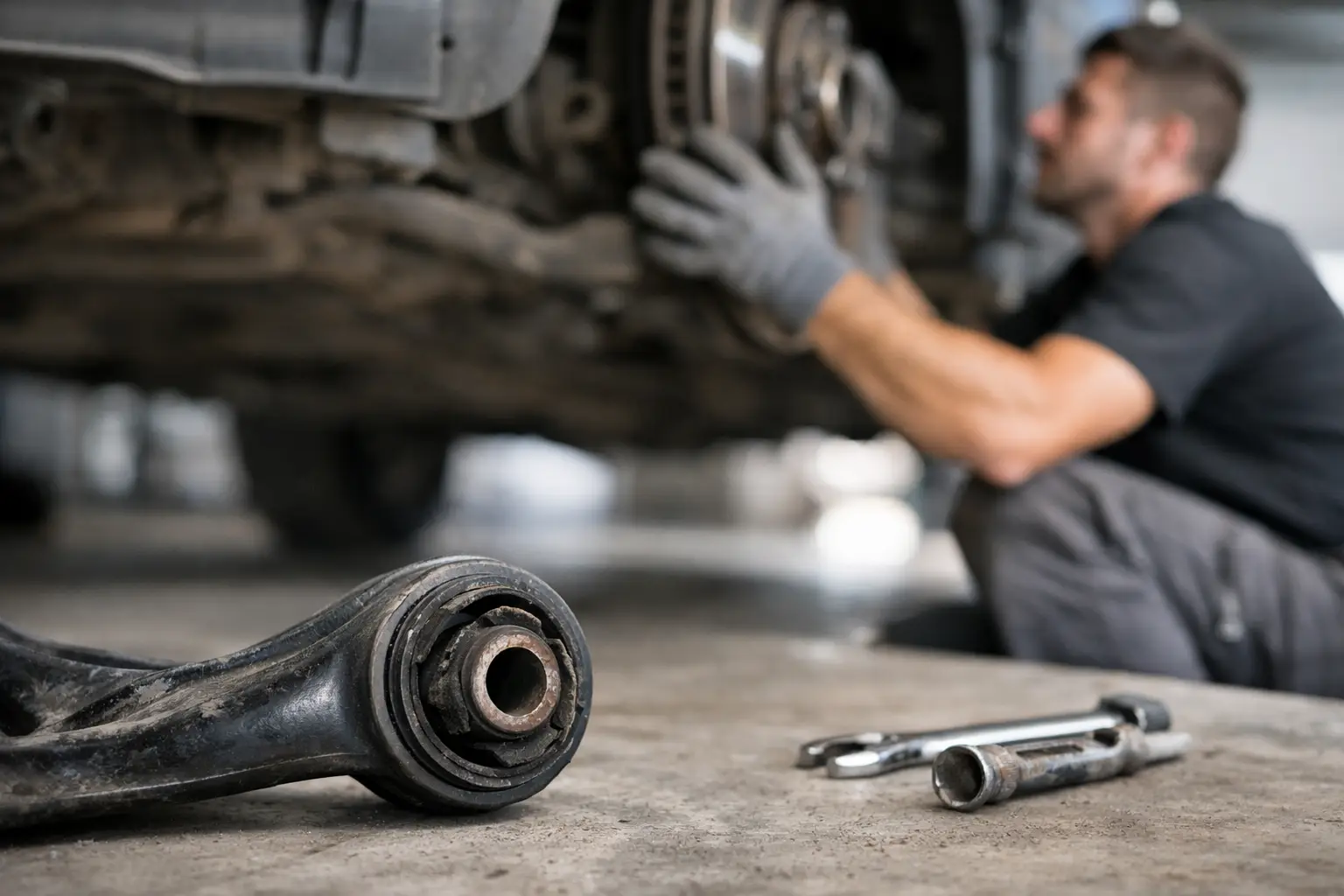
Control arm bushings are not glamorous components, but they do a demanding job. They connect the control arm to the vehicle chassis while allowing controlled movement as the suspension travels over bumps, potholes, and uneven pavement. When the rubber or bonded material wears, cracks, separates, or becomes loose, the control arm can move farther than designed. That extra movement is what drivers and technicians feel.
A control arm guides the wheel assembly through suspension movement and helps maintain the intended wheel position. Most vehicles use upper or lower control arms, and many have bushings at the inner mounting points. The bushing cushions road vibration while resisting the forward, rearward, and side-to-side loads created by braking, accelerating, cornering, and driving over rough surfaces.
A good bushing needs a careful balance. If it is too soft, the suspension can feel vague. If it is too stiff, more vibration may enter the cabin and other components can experience greater stress. OE-standard replacement bushings are designed around the vehicle's suspension geometry, mounting position, and normal driving loads. This is why correct fitment matters as much as the material itself.
A worn bushing can allow the control arm to shift abruptly when the wheel hits a pothole, speed bump, or broken road surface. The result is often a dull clunk from the front suspension. It may be more noticeable at low speeds because road and engine noise are lower.
A clunk is not exclusive to bushings. Stabilizer links, ball joints, strut mounts, loose brake hardware, and worn shock absorbers can produce similar sounds. A proper inspection should confirm the source before parts are replaced.
If the vehicle seems to drift within its lane or requires frequent small steering corrections, excess control arm movement may be contributing to the problem. Under cornering loads, a deteriorated bushing can let the wheel angle change slightly instead of holding its intended position.
Drivers may describe this as vague steering, delayed response, or a car that does not feel planted. Tire pressure, alignment, tie rod ends, and steering rack condition should also be checked, since each can produce a similar complaint.
Braking transfers a large amount of force through the front suspension. A damaged rear control arm bushing, in particular, may let the control arm shift under braking. The vehicle can feel unsettled, pull slightly to one side, or require more steering correction than usual.
This symptom deserves prompt attention. Pulling under braking can also result from brake caliper issues, uneven brake pad friction, tire problems, or alignment errors. A workshop should inspect the complete braking and suspension system rather than assume one cause.
Control arm bushing wear can alter wheel alignment angles as the vehicle moves, even if a static alignment measurement initially appears close to specification. This can lead to accelerated inner-edge or outer-edge tire wear, feathering across the tread, or repeated alignment changes that do not hold.
Replacing tires without correcting worn suspension components is an expensive short-term fix. If the bushing cannot hold the control arm in the correct position, the new tires may wear prematurely too.
Cracked, compressed, or separated bushings can reduce the suspension's ability to isolate road vibration. You might feel a shudder through the steering wheel, pedals, or floor, particularly over rough pavement or at certain speeds.
Vibration can also come from unbalanced wheels, bent rims, damaged tires, worn wheel hubs, or failing drive shafts. The road-speed pattern matters. A vibration that increases steadily with vehicle speed is often different from a bump-related vibration caused by suspension play.
Some failures are obvious during inspection. Rubber may be cracked, torn, distorted, or separated from its metal sleeve. Fluid-filled bushings may leak. The control arm may also sit off-center in its mounting bracket.
Surface cracks do not always mean immediate failure, especially on older rubber components. However, deep cracking, missing material, visible separation, or clear movement under load means the bushing should be replaced. A technician can use a pry bar carefully to check for excessive play without damaging the component.
When shifting from reverse to drive, accelerating from a stop, or lifting off the throttle, suspension loads change direction. A loose control arm bushing may allow a noticeable fore-and-aft movement that creates a thud or bump sensation.
This can be confused with worn engine mounts, transmission mounts, or drive shaft play. The difference is often where and when the noise occurs, which is why a road test and undercar inspection are more reliable than replacing parts based on sound alone.
Replace a control arm bushing when inspection confirms excessive movement, separation, major cracking, or a related handling and tire-wear issue. There is no universal mileage interval. Vehicle weight, road conditions, climate, driving style, and bushing design all affect service life.
Rough roads, repeated pothole impacts, high heat, oil contamination, and frequent heavy loads can shorten bushing life. If one bushing has clearly failed, inspect the matching side and related suspension components. The opposite side may not need replacement immediately, but comparing both sides helps prevent an incomplete repair.
In some vehicles, the bushing is available separately. In others, replacing the complete control arm is the more practical option because it may include new bushings and a ball joint. The right choice depends on labor time, the condition of the arm and ball joint, parts availability, and whether a correctly sized bushing can be installed with the proper equipment.
| Repair option | When it makes sense | Key consideration | |---|---|---| | Replace bushing only | Control arm and ball joint remain in good condition | Requires correct pressing tools and precise installation | | Replace complete control arm | Arm, ball joint, or multiple bushings show wear | Often reduces installation time and avoids repeat labor | | Replace both sides | Both sides show comparable wear or mileage | Helps restore balanced suspension response |
A new bushing will not perform as intended if it is installed incorrectly. Bushings can have a specific orientation, especially designs with voids or directional rubber sections. Installing them in the wrong position can change handling feel and reduce service life.
Final tightening is equally important. On many rubber-bushed control arms, mounting bolts should be torqued at normal ride height, not while the suspension hangs freely. Tightening at full droop can preload the rubber, causing it to twist excessively once the vehicle is lowered.
A wheel alignment should normally follow control arm or bushing replacement. Even when alignment adjustments are limited, checking the measurements verifies that the suspension is operating correctly and protects the tires.
The cheapest bushing can become the most expensive choice if the rubber compound deteriorates early, the inner sleeve is poorly bonded, or the dimensions do not match the control arm and mounting bracket. Poor fitment can create noise, make installation difficult, and lead to repeat workshop labor.
Look for replacement components with consistent manufacturing quality, accurate dimensions, durable bonding, and clear vehicle application coverage. For workshops and retailers, dependable availability matters too, particularly for fast-moving Japanese, Korean, Malaysian, and international passenger vehicle applications.
SAIKO has supplied quality-controlled aftermarket suspension components since 2007, including control arms, lower arms, ball joints, stabilizer links, strut mounts, and related steering parts across a broad range of vehicle models. Selecting the exact vehicle application and verifying the part number before installation remains essential, even when the part looks physically similar.
Do not wait for a small clunk to become unstable handling or a ruined set of tires. If your vehicle shows control arm bushing symptoms, have the suspension inspected by a qualified technician, repair the confirmed fault, and protect the comfort and control your vehicle was designed to deliver.
Recent Posts

Automotive Trade Is on the Table in the Malaysia-EU FTA. Here's Why It Matters at the Parts Counter
23 Oct 2026
The Road Transport Act Just Got Tougher. Here's What It Means for Your Car's Parts
21 Oct 2026
Drove Through Flood Water? The Parts Under Your Car That Need a Look Next
19 Oct 2026

A Record Year on the Road Means a Record Year Ahead for Maintenance
12 Oct 2026

Budget 2027 Puts E-Hailing Car Maintenance on the National Agenda
12 Oct 2026
 Whatsapp Us NowSaiko Automotive

