



Automotive Parts Demand Trends in Malaysia
A worn lower arm rarely fails at a convenient time. It shows up as tire wear, steering pull, clunks over uneven roads, or an inspection that reveals cracked bushings. That is why automotive parts demand trends are shaped less by fashion than by the practical realities of keeping aging vehicles safe, comfortable, and economical to operate.
For workshops, retailers, distributors, and vehicle owners, the clearest pattern is a stronger preference for replacement parts that fit correctly, perform consistently, and are available when the repair is needed. In Malaysia, this demand is particularly relevant across high-volume Japanese, Korean, Malaysian, and international passenger vehicles that remain on the road for many years.
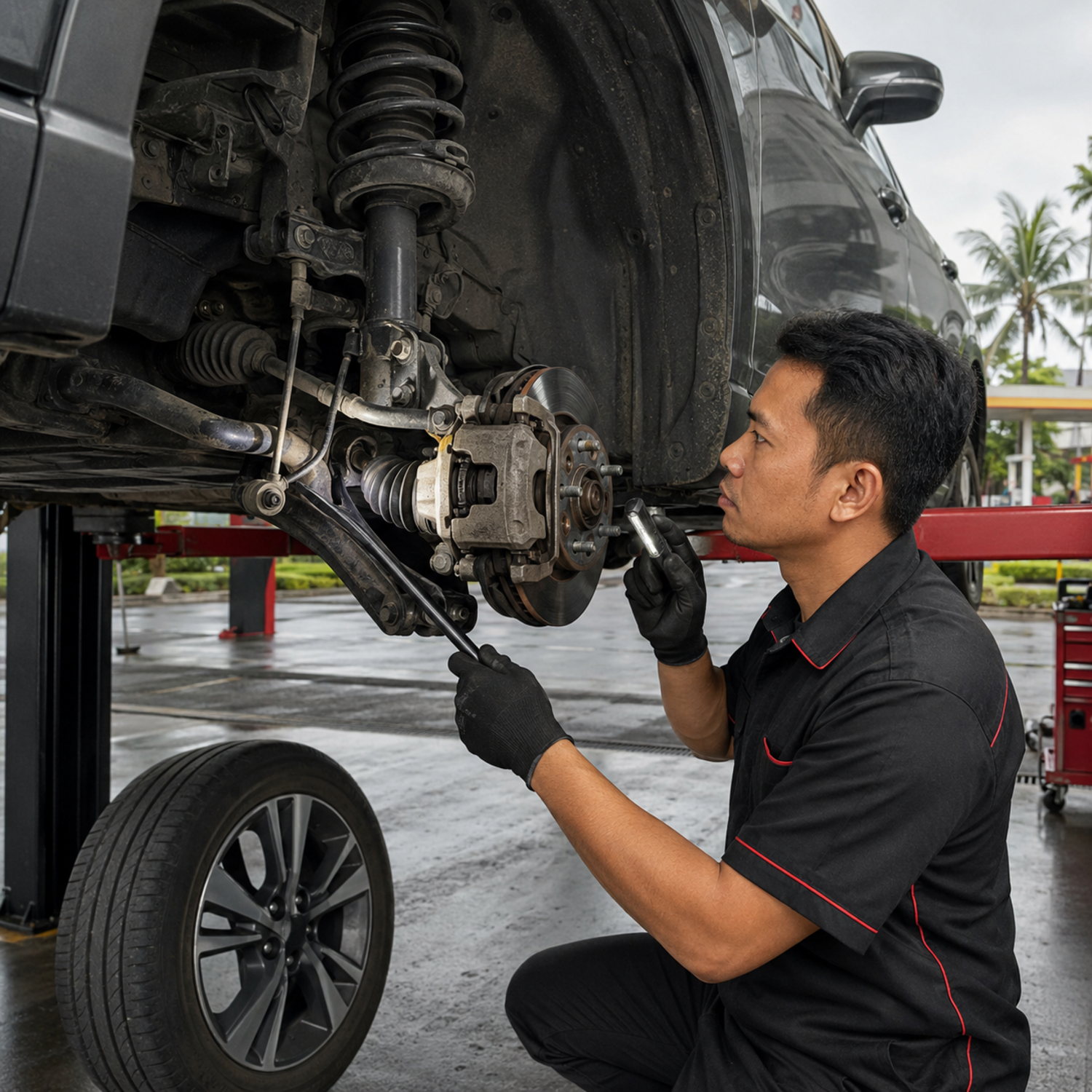
Demand is rising most consistently in categories connected to vehicle control and stopping performance. Shock absorbers, wheel hubs and hub bearings, brake pads, brake discs, control arms, ball joints, tie rod ends, rack ends, stabilizer links, and strut mounts are not optional comfort upgrades when they are worn. They directly affect handling, braking stability, tire contact, and driver confidence.
Road conditions, frequent stop-and-go traffic, heavy rain, potholes, speed bumps, and long commuting distances all place repeated stress on suspension and steering components. A vehicle may still move with a loose ball joint or weak shock absorber, but its response during emergency braking or cornering can be less predictable. This makes safety-critical parts a steady source of workshop demand rather than a seasonal purchase.
The trade-off is clear. Low-priced parts may attract buyers at the counter, but poor material quality, inconsistent dimensions, or weak sealing can lead to noise, early wear, alignment issues, and repeat labor. Workshops increasingly protect their reputation by choosing parts with dependable quality control and accurate fitment.
New vehicle sales influence future parts demand, but the current aftermarket is driven by the vehicles already on the road. As cars age, replacement needs move beyond oil filters and brake service into suspension, steering, drivetrain, and engine-timing repairs.
A driver may first replace brake pads, then return later for brake discs, wheel hub bearings, drive shafts, or lower arms as mileage increases. These repairs are often interconnected. For example, replacing a worn lower arm without checking ball joints, stabilizer links, tire condition, and alignment can leave the vehicle with unresolved handling problems.
This creates an opportunity for workshops to perform condition-based inspections rather than selling parts in isolation. A clear explanation of the failed component, its symptoms, and the risks of delaying replacement helps customers make informed decisions. It also reduces the chance of a customer returning because another worn component was missed during the original diagnosis.
Several product groups are likely to remain in regular demand because their wear is predictable and their effect on vehicle operation is easy to notice:
For retailers, these categories can produce repeat business when stocked for common vehicle applications. For workshops, availability matters because customers facing a safety repair usually do not want to wait days for a basic replacement part.
One of the most important automotive parts demand trends is the shift from simply asking, “Do you have this part?” to asking, “Is this the correct part for my exact vehicle?” Modern vehicle ranges can have different engine sizes, production years, trim levels, braking systems, and suspension layouts. Two vehicles with similar names may require different parts.
Accurate fitment reduces installation delays, modification work, returns, and safety concerns. A brake pad with the wrong backing plate shape, a hub bearing with incorrect sensor compatibility, or a control arm that does not match the original mounting points can turn a routine repair into an expensive problem.
Workshops should confirm the vehicle model, year, engine, transmission where relevant, and original part reference before ordering. Retailers can add value by maintaining clear application data and helping customers distinguish between similar-looking components. Price matters, but a part that installs correctly the first time often delivers better overall value than a cheaper option that creates extra labor.
Vehicle owners are price-conscious, especially when several repairs are recommended at once. However, demand is moving toward value rather than the lowest possible purchase price. Total repair cost includes the component, labor, alignment, downtime, and the possibility of doing the same job again if the part fails prematurely.
This is especially true for labor-intensive jobs. Replacing a wheel hub, drive shaft, steering rack, or lower arm can require significant workshop time. Saving a small amount on the part is rarely worthwhile if the replacement has poor durability or causes a fitment issue.
A reliable aftermarket part should offer a sensible balance of material quality, controlled manufacturing, precise dimensions, and competitive pricing. For car owners comparing aftermarket brake pads or wheel hubs, the best choice is usually not a vague brand claim. It is a properly matched part from a supplier that can explain its application, quality standard, and local support.
The aftermarket is not only changing because of the parts being sold. Buyers increasingly expect faster answers, stable supply, and support after purchase. Workshops need the right item to keep service bays moving. Retailers need products that customers trust and that do not create excessive returns. Distributors need coverage across common vehicle platforms and confidence that product quality will remain consistent from batch to batch.
Since 2007, SAIKO has served this need with OE-standard tested replacement parts covering more than 400 vehicle models, supported through a nationwide network of over 500 dealers and distributors. Its range spans suspension, steering, braking, drivetrain, and engine-timing components for widely used passenger vehicles, giving workshops and retailers a practical source for fast-moving repair categories.
Local support is particularly valuable when a workshop needs to verify an application or source a replacement quickly. A part supplier should be judged not only by the box on the shelf, but also by its ability to provide accurate information, consistent availability, and dependable service when a repair is underway.
Preventive maintenance can change when parts are purchased, but it does not eliminate demand. Drivers who inspect their vehicles regularly tend to replace components before a small issue becomes a larger repair. For example, replacing cracked strut mounts before severe noise develops, or addressing a torn CV boot before the drive shaft joint is contaminated, can avoid more costly work.
Workshops can encourage this behavior through practical checks during routine services. Inspect brake thickness and disc condition, listen for bearing noise, check suspension bushes for cracks, examine shocks for leakage, and look for play in steering joints. These checks should be based on observed condition, not automatic upselling.
For owners, warning signs deserve attention: vibration at speed, grinding during braking, repeated pulling to one side, clunking over bumps, uneven tire wear, steering looseness, and clicking during turns. The correct replacement interval depends on driving habits, road exposure, load, vehicle age, and part condition. There is no single mileage figure that applies to every car.
The strongest demand will continue to favor replacement parts that solve real workshop and driver problems: correct fitment, dependable performance, reasonable pricing, and ready access to support. Safety-related repairs cannot be treated as a place to compromise blindly, especially when suspension, steering, brakes, and drivetrain components affect how a vehicle behaves on the road.
For buyers, the most useful question is not simply which part is cheapest. Ask whether it matches the vehicle correctly, suits the repair, and comes from a supplier prepared to stand behind consistent quality. That approach keeps cars safer, workshops more efficient, and replacement spending focused on lasting value.
Recent Posts
.png "Image")
Vehicle Theft in Malaysia: Why Genuine Replacement Parts Matter More Than Ever
07 Sep 2026
.png "Image")
Isuzu's 1,756km One-Tank Run and the Suspension Secret Behind Fuel Efficiency
05 Sep 2026
Bigger Budi95 Quota, More Mileage: What It Means for Your Car's Suspension
03 Sep 2026
.png "Image")
What China's 4.3 Million Car Recall Teaches Malaysian Drivers About Mechanical Reliability
01 Sep 2026
.png "Image")
Malaysia's Road Maintenance Funding Gap — What It Means for Suspension and Steering Wear
28 Aug 2026
 Whatsapp Us NowSaiko Automotive

