


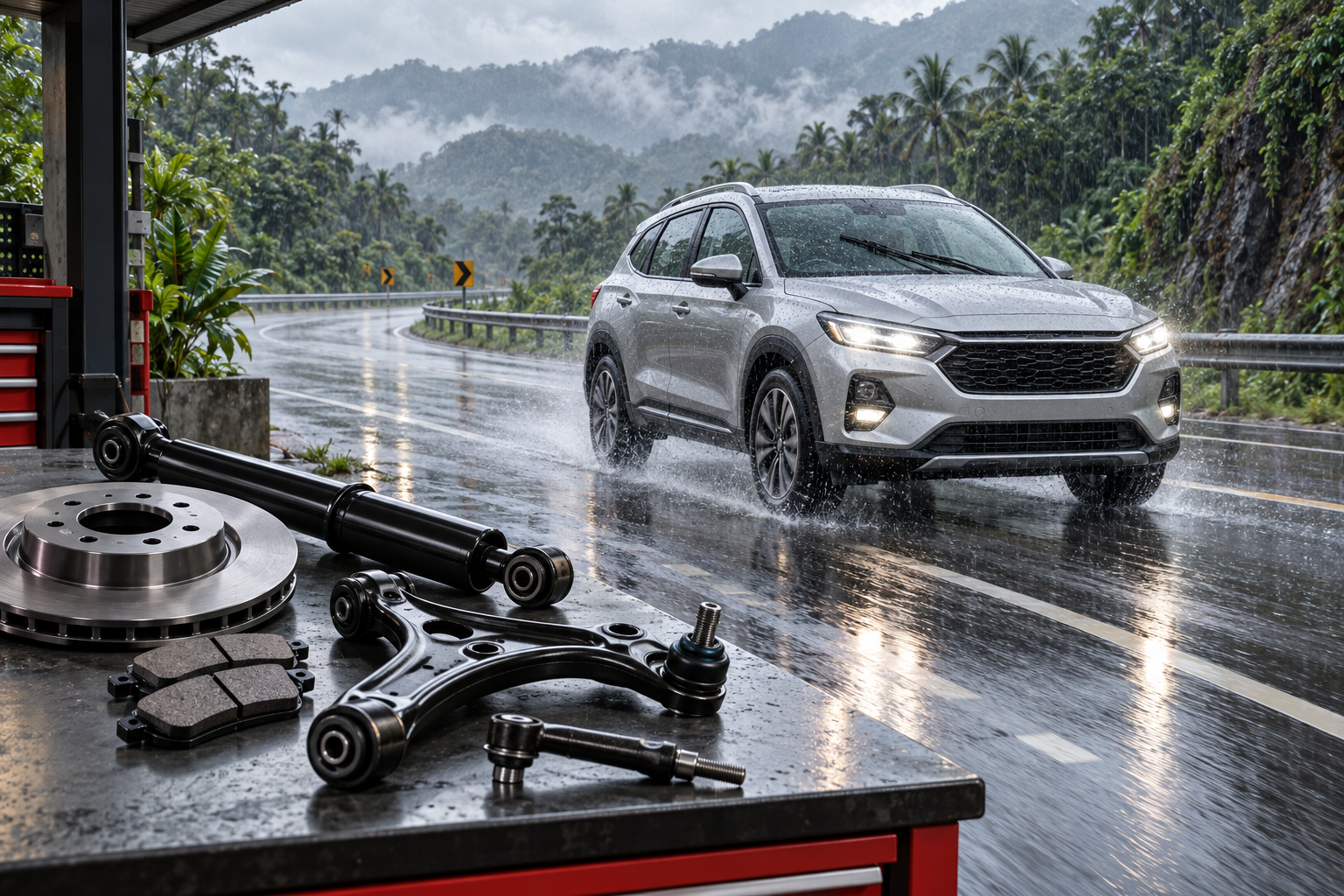
The Monsoon Has Arrived. Is Your Car Ready to Stay in Control on Wet Roads?
Every year Malaysia goes through a long stretch of heavy rain, and every year the same question comes up. A proper monsoon season car check in Malaysia is not only about wipers and tyres. On a wet road, the parts that keep a car stable, steerable and able to stop are the brakes, the shock absorbers and the steering and suspension joints that hold the tyres in contact with the road.
On 27 October 2026, Malay Mail reported Deputy Prime Minister Datuk Seri Ahmad Zahid Hamidi urging the public to stay alert as the 2026/2027 Northeast Monsoon began. The monsoon is expected to last until March 2027, and MetMalaysia forecasts three to five episodes of prolonged heavy rain between November 2026 and January 2027. "Safety for yourself and your family must come first," he said, and he advised the public to monitor forecasts, avoid flood-prone areas and never cross floodwater.
That advice is about avoiding the worst conditions. This article is about the ordinary wet commute, the highway drive in heavy rain and the trip back to the east coast for the holidays, and what keeps a car under control on those roads.
On a dry road, a car with tired components can feel fine. Grip is plentiful, so small weaknesses stay hidden. Rain removes that margin. Water between the tyre and the road reduces the grip available, so the car depends more on every part of the chassis doing its job precisely.
Three systems matter most:
None of these parts fails dramatically in most cases. They wear slowly, and drivers adapt without noticing. The monsoon is often when that gradual wear starts to show.
A workshop inspection is the most reliable way to assess chassis condition, but drivers can spot many early warning signs themselves. Watch and listen for:
If you notice any of these, have them looked at before a long drive in poor weather rather than after.
Tyres get most of the attention in wet-weather advice, and rightly so. Tread depth and correct pressure are essential. New products also keep arriving: on 31 October 2026, paultan.org reported that Nexen Tire Malaysia had launched two new tyres it described as designed for Malaysia's hot, wet climate, with claims of shorter wet braking distances than their predecessors.
But even the best tyre can only work as well as the suspension holding it. A tyre's grip depends on its contact patch, the small area actually touching the road. Worn shock absorbers let that contact patch lighten and bounce. A slack ball joint or tie rod end lets the wheel move off its intended angle. Tired bushings and stabilizer links allow more body roll in a quick lane change.
This is why it helps to think of chassis parts as one connected system:
Compromise one link and the others work harder. That is the principle behind SAIKO's chassis ecosystem: every component is part of one system, and compromising one part compromises overall safety.
With several months of heavy rain ahead, a few simple habits go a long way:
Malaysia's monsoon is predictable even when individual storms are not. What drivers can control is the condition of the parts that keep the car steady, responsive and able to stop. When replacements are needed, choose components built to the vehicle specification, fitted correctly and designed to work with the rest of the system.
SAIKO has supplied quality-controlled automotive replacement parts since 2007, with coverage for more than 400 vehicle models and a nationwide dealer network, across steering, suspension, brake and drivetrain components. Before the heaviest rain arrives, have your car checked and drive the season with confidence.
Find a SAIKO dealer near you at saiko.com.my
Recent Posts
RON95 at RM1.99: Cheaper Kilometres Still Wear Out Parts
30 Oct 2026
Built Here: What CKD Assembly Means for Malaysia's Parts and Service Ecosystem
28 Oct 2026
Passing Inspection Isn't the Same as Being Roadworthy
26 Oct 2026
Automotive Trade Is on the Table in the Malaysia-EU FTA. Here's Why It Matters at the Parts Counter
23 Oct 2026
The Road Transport Act Just Got Tougher. Here's What It Means for Your Car's Parts
21 Oct 2026
 Whatsapp Us NowSaiko Automotive

