


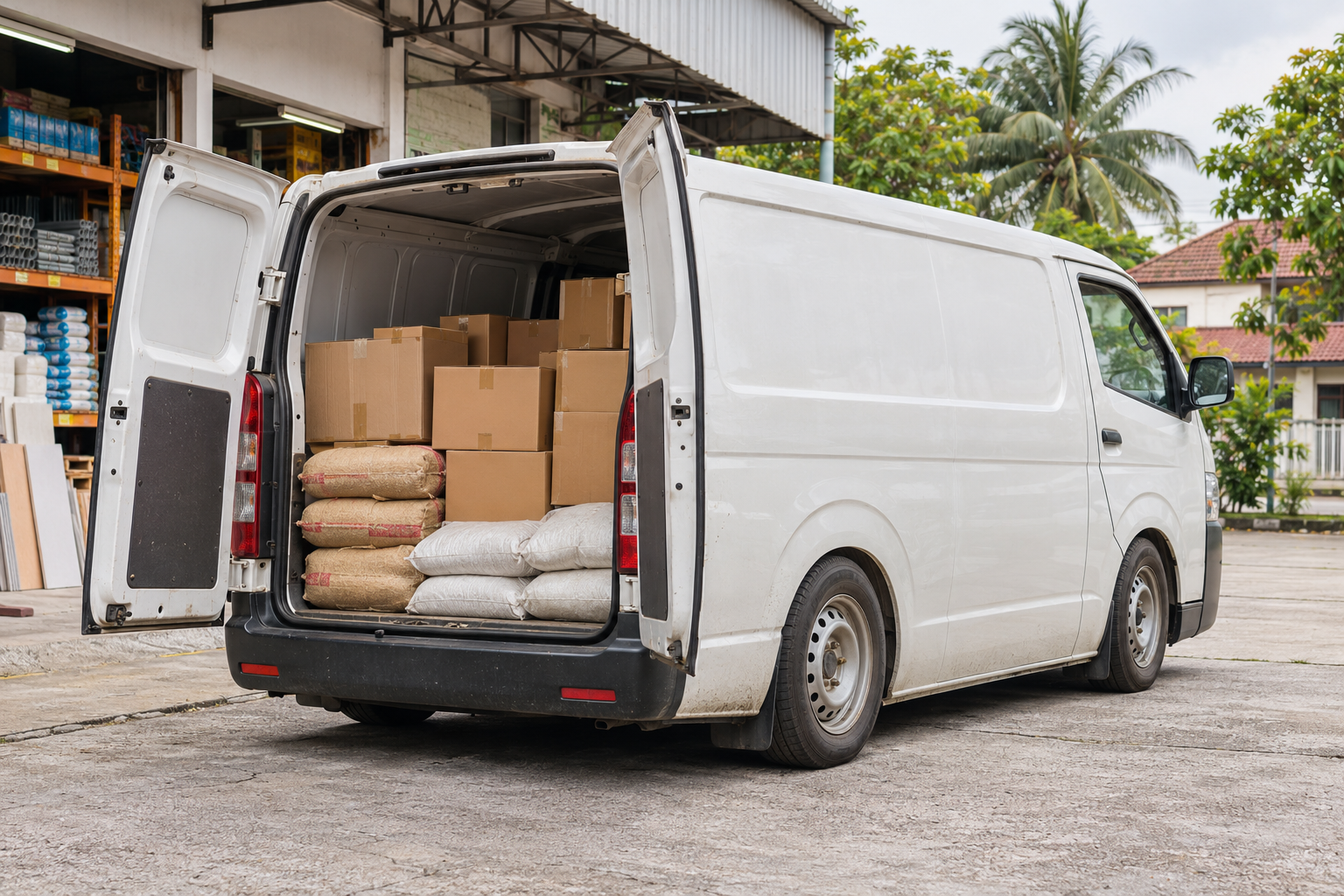
The Overloading Crackdown: What Extra Weight Does to Your Chassis
Overloading usually makes the news because of lorries and enforcement operations, but vehicle overloading and suspension damage is a concern for far more people than commercial hauliers. The delivery van carrying one more stack of boxes, the pickup loaded with building materials, and the family MPV packed to the roof for the trip home all put loads on springs, joints, bearings and brakes that those parts were never specified to carry.
Overloading was back in the headlines this week. Bernama reported on 11 November 2026 that Anthony Loke, speaking at the Transport Ministry's monthly assembly after his resignation as minister took effect, urged the Road Transport Department (JPJ) and the Malaysian Institute of Road Safety Research (MIROS) to sustain road safety efforts. He said strict enforcement against overloaded vehicles, illegal racing and speeding must continue regardless of leadership changes, noting that legal amendments have been enacted and enforcement powers given to JPJ officers. "The fight against overloaded vehicles is not the agenda of any individual or minister but a national mission that must continue because it concerns human safety and lives," he was reported as saying.
Enforcement is one side of the story. The other is mechanical.
Every vehicle is engineered around a maximum laden weight, the total the manufacturer has validated for its springs, dampers, axles, tyres, brakes and frame. Commercial vehicles have their permitted weight on their registration documents, and passenger cars list payload or gross vehicle weight in the owner's manual and often on a door-pillar label.
Suspension geometry, brake capacity and tyre load ratings are all calculated around that limit. Go past it and every system works outside its tested range. Nothing may break straight away, which is why overloading is so easy to get used to.
Excess weight affects the whole chassis, not just the rear springs. Common consequences include:
Fleet managers and owners can watch for these signs, which often show up before any failure:
Staying within limits protects people first, and it also protects the vehicle and the business that depends on it.
For components that carry the most load, durability margins matter. In SAIKO's 7.0 kN stress survival test, its ball-joint-style components completed 247,274 cycles with no damage, compared with 100,000 cycles for an OEM part and 50,000 for a competing aftermarket part. According to SAIKO, that is up to 2× longer than OEM and up to 4× longer than competitors. That reserve is reassuring for hard-working vehicles. It is not a licence to exceed the manufacturer's load limit, which exists for good reason.
The call to keep enforcing against overloading is a reminder that safe roads depend on every vehicle being driven within its limits and kept in good mechanical condition.
SAIKO has supplied quality-controlled automotive replacement parts since 2007, covering more than 400 vehicle models through a nationwide dealer network. From coil springs and shock absorbers to ball joints, tie rod ends and brake parts, our range is built for the demands of everyday Malaysian driving.
If your van, pickup or family car has been working hard, have its chassis inspected and find a SAIKO dealer at saiko.com.my
Recent Posts
How to Tell If Your Car Absorber Is Worn Out on Malaysian Roads
16 Nov 2026
Record Hybrid and EV Registrations: Why Electrified Cars Still Need Chassis Care
16 Nov 2026
Recurring Road Damage: What Patched and Re-Patched Roads Do to Your Suspension
16 Nov 2026
RON95 Goodwill Payments Show Why Your Car's Paper Trail Matters
12 Nov 2026
After the Deepavali Drive: The Post-Trip Check Your Car Deserves
10 Nov 2026
 Whatsapp Us NowSaiko Automotive

