


Record Hybrid and EV Registrations: Why Electrified Cars Still Need Chassis Care
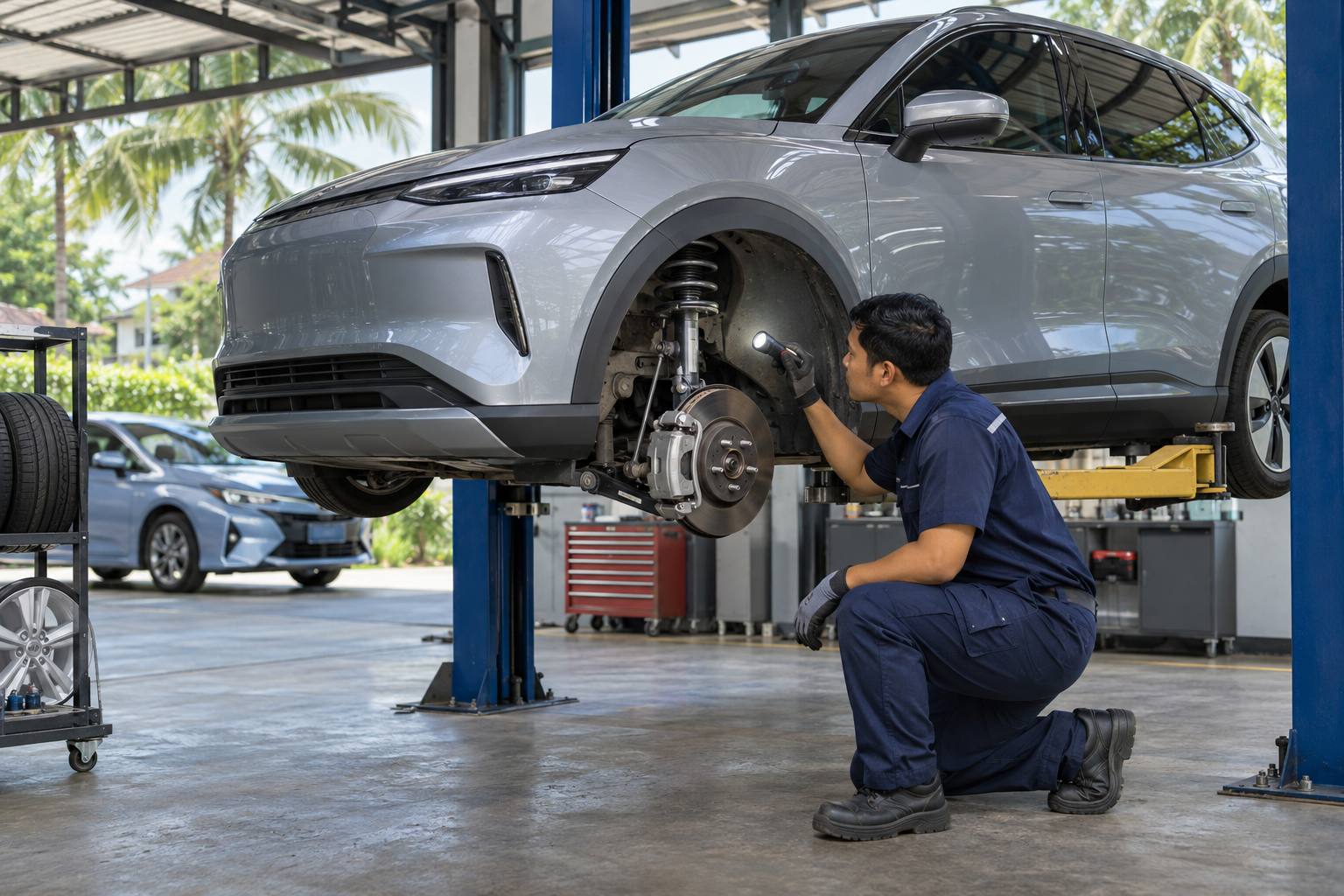
Malaysia's electrified fleet has crossed another milestone, and it raises a question many new owners haven't been told to ask: what does hybrid and EV suspension maintenance actually involve? An electric motor removes the oil changes and spark plugs, but it doesn't remove the springs, dampers, ball joints, tie rods, wheel bearings and brakes that keep the car planted and under control.
According to JPJ registration data reported by paultan.org on 12 November 2026, 715,879 new vehicles were registered in Malaysia from January to October 2026. That is the highest first-ten-months total on record and 3.0% ahead of the same period in 2025. Within that total, electrified vehicles stood out: year-to-date registrations of EVs (58,129) and hybrids (45,204) have each already passed their full-year 2025 totals of 44,813 and 31,190.
Together, that is more than 103,000 electrified vehicles in ten months, roughly one in seven new registrations. Those cars will need chassis care in the years ahead, and they need it in slightly different ways.
The suspension and steering layout of most hybrids and EVs will look familiar to any technician: MacPherson struts, control arms, stabilizer links, tie rod ends and hub bearings. What changes is how hard those parts are worked and how wear shows up.
It depends on the model, the roads and how the car is driven, so there is no single answer. The direction is clear, though: a heavier car carrying the same impacts asks more of its chassis components. Owners and workshops should expect suspension, steering and tyres to deserve at least the same attention as on a conventional car, and often more.
Warning signs to watch for:
Electrified cars often come with simplified service schedules, which makes it easy to overlook the parts that don't run on electricity. Add these to every visit:
A record number of electrified cars today means a growing pool of hybrids and EVs coming off warranty in a few years, ready for independent servicing. The high-voltage systems stay specialist work. The chassis, though, is familiar territory for skilled technicians, as long as they have accurate fitment data and parts built to handle the loads.
That is where engineering detail counts. SAIKO's ball joints use POM (polyoxymethylene) bearing technology in place of conventional metal-to-metal contact. POM is self-lubricating, low-friction and highly wear-resistant, and SAIKO's ball joints are sealed and maintenance-free. In SAIKO's 7.0 kN stress survival test, its ball-joint-style components ran 247,274 cycles with no damage, compared with 100,000 cycles for an OEM part. That is up to 2× longer than OEM, according to SAIKO, and the kind of margin that matters on a heavier car. The quiet operation of POM bearings also suits a quiet electrified cabin, where noise is more noticeable.
The powertrain changed; physics didn't. Every electrified car still meets the same roads, the same potholes and the same monsoon rain as every other car. Its springs, joints, bearings and brakes still decide how safely it rides, steers and stops.
SAIKO has supplied quality-controlled automotive replacement parts since 2007, covering more than 400 vehicle models through a nationwide dealer network, with an expanding range built to support Malaysia's changing vehicle parc.
Driving a hybrid or EV? Have its chassis inspected at your next service, and find a SAIKO dealer at saiko.com.my
Recent Posts
How to Tell If Your Car Absorber Is Worn Out on Malaysian Roads
16 Nov 2026
Recurring Road Damage: What Patched and Re-Patched Roads Do to Your Suspension
16 Nov 2026
RON95 Goodwill Payments Show Why Your Car's Paper Trail Matters
12 Nov 2026
After the Deepavali Drive: The Post-Trip Check Your Car Deserves
10 Nov 2026
21,624 Protons in One Month: What a Growing National Fleet Means for Parts and Service
10 Nov 2026
 Whatsapp Us NowSaiko Automotive

