


Recurring Road Damage: What Patched and Re-Patched Roads Do to Your Suspension
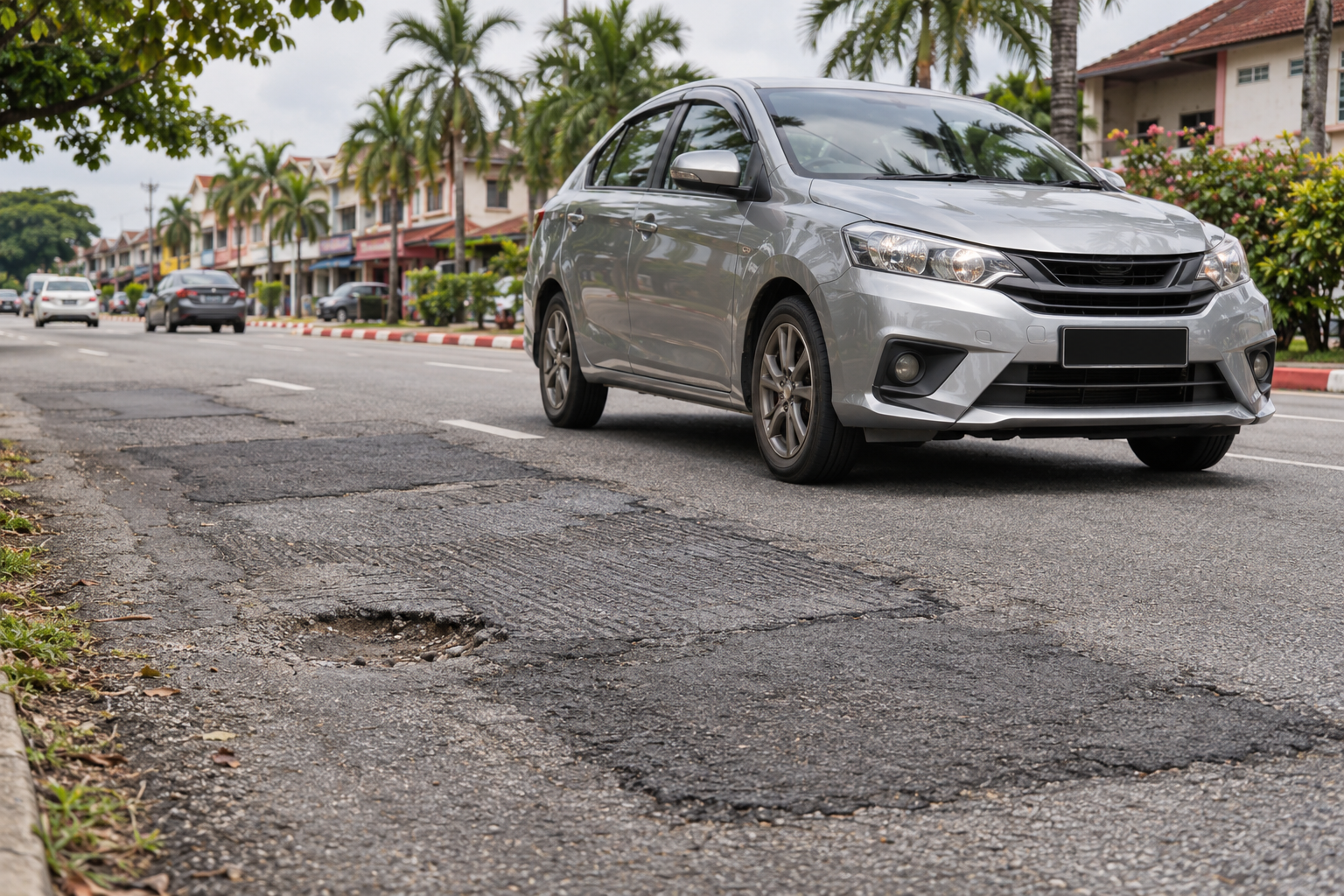
Every Malaysian driver knows the stretch: the same pothole, patched, broken and patched again. When it comes to road damage and your car's suspension, the problem is rarely one dramatic impact. It is the hundreds of small, sharp hits from uneven patches, sunken utility trenches and ridged resurfacing that wear down chassis parts quietly, month after month.
That pattern got official attention this week. In a Dewan Rakyat reply reported by The Edge Malaysia on 11 November 2026, Deputy Works Minister Datuk Seri Dr Ahmad Maslan said poor-quality resurfacing by contractors and utility companies is among the causes of recurring damage on federal roads that need repeated patching. He also named heavy vehicles exceeding load limits, drainage, weather and road age as factors. According to the report, RM10.6 billion was spent on maintenance and repair of federal roads nationwide from 2021 to 2025.
Road maintenance is for the authorities. What happens underneath your car is something every owner can manage.
A deep pothole gets your attention. Repeated patching is subtler: a patch that sits a few millimetres proud of the road, a trench that has settled, or a resurfaced lane that ends in a sharp lip all send short, high-frequency shocks into the suspension.
Your suspension is built to absorb those inputs, but each one is a load cycle. Rubber bushings flex, ball joints articulate under load, and dampers work harder to settle the body. Over thousands of kilometres on an uneven daily commute, that adds up to faster wear than the same mileage on smooth highway.
Worn components also pass more of the next shock to their neighbours. Every chassis component is part of one ecosystem: compromising one part compromises overall safety.
On uneven, repeatedly patched roads, these are the components workshops most often find worn:
Most wear gives warning before it becomes a problem. Pay attention to:
If you hit a particularly bad pothole or patch, have the suspension and alignment checked soon afterwards rather than waiting for the next service.
You can't choose the roads you drive on, but you can choose how closely you watch your car.
SAIKO's own testing shows why quality matters here. In its 7.0 kN stress survival test, SAIKO ball-joint-style components ran 247,274 cycles with no damage, against 100,000 cycles for an OEM part and 50,000 for a competing aftermarket part. That is up to 2× longer than OEM, according to SAIKO, which counts for a lot on roads that load the suspension every day.
Patched roads are part of daily life in Malaysia, and they test every component underneath your car. Fortunately, suspension wear is predictable and straightforward to fix when caught early.
SAIKO has supplied quality-controlled automotive replacement parts since 2007, covering more than 400 vehicle models through a nationwide dealer network. Our steering and suspension range, from control arms and stabilizer links to tie rod ends, rack ends and shock absorbers, is engineered for precise control on real Malaysian roads.
If your car has started to knock, wander or bounce, have it inspected and find a SAIKO dealer near you at saiko.com.my
Recent Posts
How to Tell If Your Car Absorber Is Worn Out on Malaysian Roads
16 Nov 2026
RON95 Goodwill Payments Show Why Your Car's Paper Trail Matters
12 Nov 2026

After the Deepavali Drive: The Post-Trip Check Your Car Deserves
10 Nov 2026
21,624 Protons in One Month: What a Growing National Fleet Means for Parts and Service
10 Nov 2026
Malaysia's Automotive Workforce Is Growing. Here's Why Skills Matter for Every Repair
06 Nov 2026
 Whatsapp Us NowSaiko Automotive

