


Why Do Wheel Bearings Fail? Causes and Fixes
A low hum that rises with road speed is easy to dismiss as tire noise. But when drivers ask, why do wheel bearings fail, that sound is often the first useful clue. A worn bearing can quickly affect steering stability, tire wear, braking confidence, and, in severe cases, the wheel's ability to rotate safely.
Wheel bearings are built to carry substantial loads, but they are not maintenance-free in every situation. Road impacts, water entry, incorrect installation, and poor-quality replacement parts can shorten their service life well before normal wear should become a concern. Knowing the cause matters because replacing only the bearing without correcting the underlying issue can lead to another premature failure.
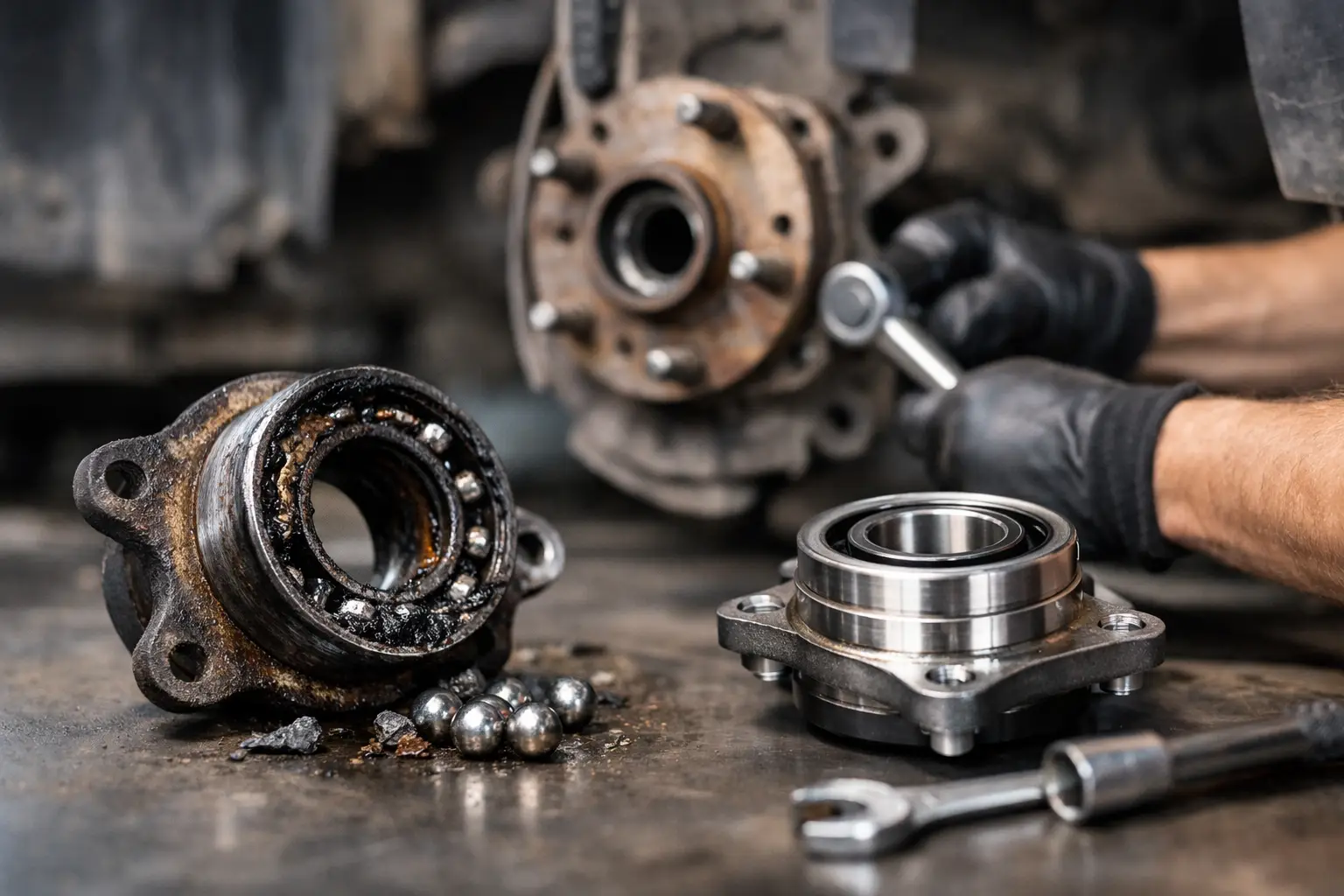
A wheel bearing is a precision assembly that allows the wheel hub to rotate smoothly while supporting the vehicle's weight and the forces created by braking, cornering, and acceleration. On many newer vehicles, the bearing is integrated into a hub assembly. On others, it is a separate pressed-in component.
Inside the assembly, hardened steel balls or rollers run on smooth races under a protective seal and lubricating grease. When these surfaces remain clean, lubricated, and correctly loaded, the bearing operates quietly. Once the seal leaks, the bearing is overloaded, or the internal surfaces are damaged, friction and noise begin to build.
The bearing seal is the first line of defense against water, dust, road grit, and salt. A torn seal or damaged hub surface allows contamination to reach the grease. Water can cause corrosion, while dirt acts like an abrasive between the rolling elements and races.
This is especially relevant after driving through deep standing water, flooded roads, or muddy construction areas. Water exposure does not always cause immediate noise. Corrosion may begin inside the bearing and only become noticeable weeks or months later as the damaged surfaces wear.
A hard pothole strike or curb impact sends a sharp load through the wheel, tire, hub, and bearing. The bearing races can develop tiny dents known as brinelling. These marks create vibration every time the rollers or balls pass over them, producing the familiar growl or humming sound.
The wheel may look undamaged after an impact, yet the bearing can still be compromised. If the vehicle develops noise, vibration, pulling, or uneven tire wear after a severe hit, the workshop should inspect the tire, wheel, suspension joints, alignment, and wheel bearing together.
Many early bearing failures are installation-related. Pressing a bearing in through the wrong race transfers force through the rolling elements and can damage it before the vehicle leaves the workshop. Reusing a damaged hub, striking the bearing with a hammer, or failing to clean the bearing bore can also prevent proper seating.
Axle-nut torque is equally critical. A loose axle nut can allow movement that damages the bearing and hub splines. An overtightened nut can apply excessive preload and generate heat. The correct torque specification, tightening sequence, and any required new hardware should always be followed for the specific vehicle.
A wheel bearing is designed for controlled loads, not constant shock and movement. Worn lower arms, ball joints, control arm bushings, tie rod ends, or strut mounts can allow the wheel to move in ways it should not. That movement increases stress on the bearing during braking and cornering.
Replacing a noisy bearing without checking these surrounding components may solve the sound temporarily but not the root cause. This is why a complete front-end or rear-end inspection offers better value than treating a wheel bearing as an isolated problem.
Not all aftermarket wheel bearings are made to the same standard. Inconsistent heat treatment, poorly finished races, insufficient grease, and weak seals can reduce durability. The lowest-priced part may appear similar from the outside, but internal precision and sealing quality determine how well it handles heat, moisture, and repeated road loads.
For workshops and parts retailers, reliable fitment is also part of quality. A bearing that does not seat correctly, has an inaccurate sensor ring, or includes unsuitable hardware can increase installation time and create avoidable comebacks.
Even a properly installed bearing eventually wears. Long mileage, frequent stop-and-go driving, rough roads, repeated heavy loads, and aggressive cornering all contribute. There is no universal replacement interval because driving conditions, vehicle weight, and component quality vary widely.
A family sedan used mainly on smooth highways may keep its original bearings for many years. A vehicle frequently used on damaged roads, carrying heavy cargo, or exposed to water may need attention much sooner.
The most common symptom is a humming, rumbling, growling, or droning noise that increases with vehicle speed. Unlike engine noise, it usually continues whether the transmission is in gear or neutral. The sound may change when the vehicle turns because cornering shifts load from one side of the vehicle to the other.
Other symptoms can include steering-wheel vibration, a loose or wandering feel, uneven tire wear, or a wheel that feels rough when rotated during inspection. In advanced cases, there may be noticeable wheel play, a warning light related to a wheel-speed sensor, or overheating near the hub.
Noise alone does not confirm the diagnosis. Cupped tires, uneven tread wear, brake drag, and some drivetrain faults can sound similar. A technician should road-test the vehicle, check the tires, inspect for free play, and evaluate the hub assembly before recommending replacement.
A proper diagnosis starts with a road test to identify whether the noise changes with speed or direction. The vehicle is then safely raised so the technician can check wheel movement, rotate the wheel by hand, inspect the brake components, and look for damaged seals or signs of heat.
On vehicles with integrated wheel-speed sensors, the electrical connector and sensor signal should also be checked. A damaged encoder ring or sensor issue can trigger an ABS or traction-control warning, even when the mechanical bearing noise is still mild.
A useful rule is to avoid guessing based only on which side sounds louder inside the cabin. Sound travels through the chassis, and a failing bearing on one side can seem to come from the other. Confirmation through inspection prevents unnecessary parts replacement.
The correct choice depends on the vehicle design. Some applications require a complete hub assembly, while others use a separate bearing that must be pressed into the steering knuckle. The vehicle's make, model, year, engine, drivetrain, ABS configuration, and hub dimensions all need to match.
Look for a replacement component with accurate machining, durable sealing, correct sensor compatibility where applicable, and hardware designed for the application. A bearing is not a part where visual similarity is enough. Precise fitment helps preserve correct wheel alignment, braking performance, and sensor operation.
For passenger vehicles across Japanese, Korean, Malaysian, and other international applications, SAIKO supplies quality-controlled wheel hubs and hub bearings designed around practical fitment, dependable performance, and value for workshops and vehicle owners. Choosing a trusted supplier also makes it easier to source related suspension and steering components when inspection reveals broader wear.
Driving with a mild noise for a short distance may be possible, but it is not a repair to postpone casually. Bearing damage usually progresses, and noise is not a reliable measure of remaining life. As internal wear increases, excess heat and play can affect handling, braking, tire wear, and wheel-speed sensor readings.
If the vehicle has wheel looseness, strong vibration, grinding, an ABS warning, or visible hub damage, it should be inspected immediately. Continuing to drive in that condition increases both repair cost and safety risk.
Avoiding every failure is unrealistic, but several habits reduce unnecessary stress. Slow down for potholes and road edges, avoid deep water when possible, and have the suspension inspected when tires wear unevenly or the vehicle begins to pull. After a curb strike or major impact, do not wait for noise before checking the wheel and suspension.
During replacement, correct installation matters as much as the part itself. Use the right tools, replace single-use axle hardware when specified, torque fasteners to the vehicle manufacturer's specification, and inspect the mating hub and surrounding joints. A properly selected, properly installed bearing gives the vehicle the quiet, controlled operation drivers expect - and gives the repair a better chance of lasting.
Recent Posts
Automotive Trade Is on the Table in the Malaysia-EU FTA. Here's Why It Matters at the Parts Counter
23 Oct 2026
The Road Transport Act Just Got Tougher. Here's What It Means for Your Car's Parts
21 Oct 2026
Drove Through Flood Water? The Parts Under Your Car That Need a Look Next
19 Oct 2026
A Record Year on the Road Means a Record Year Ahead for Maintenance
12 Oct 2026
Budget 2027 Puts E-Hailing Car Maintenance on the National Agenda
12 Oct 2026
 Whatsapp Us NowSaiko Automotive

