


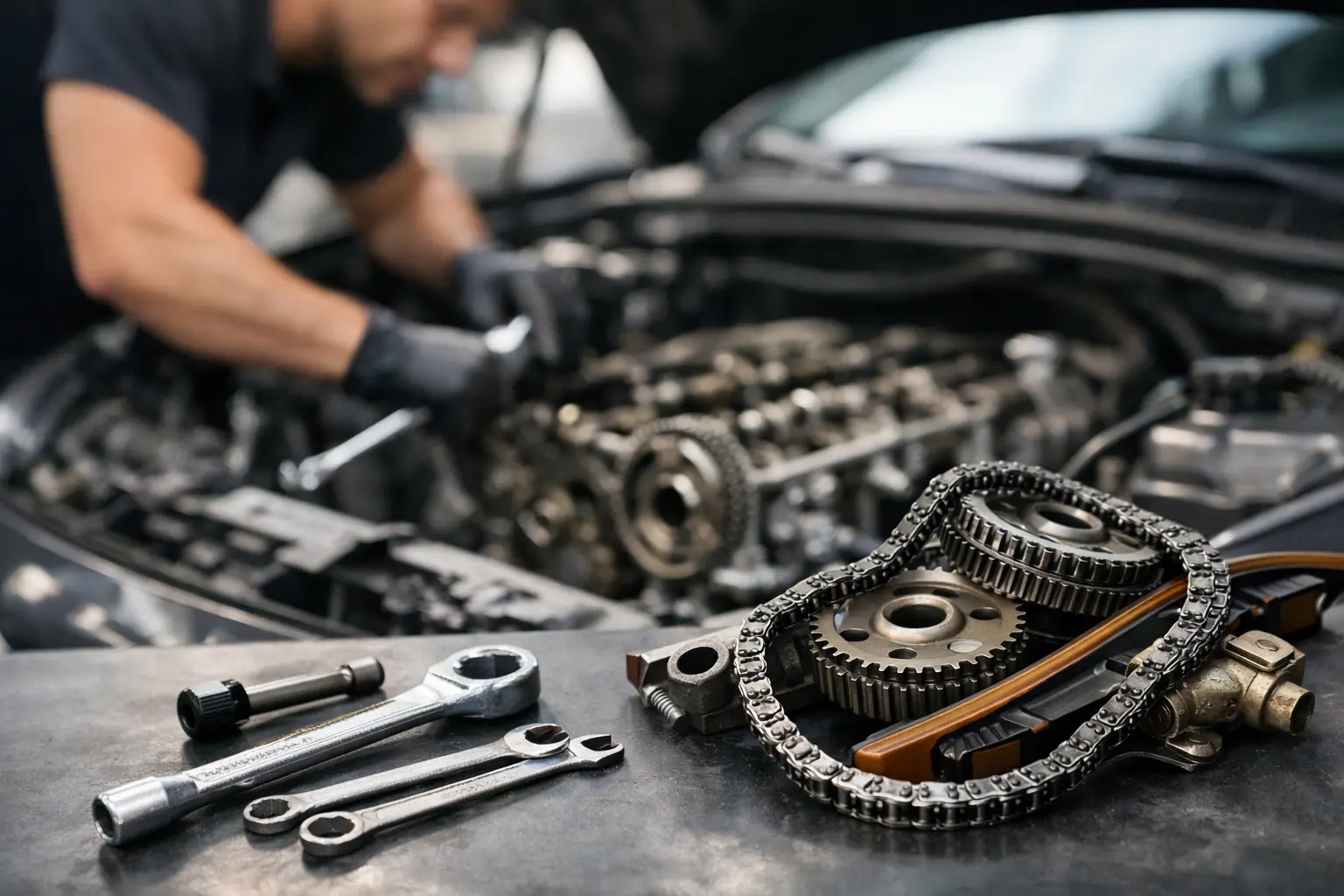
Timing Chain Replacement Guide for Drivers
A rattling sound on cold start is easy to ignore until it turns into a no-start, poor engine performance, or serious internal damage. That is why a timing chain replacement guide matters for both vehicle owners and workshops. The timing chain keeps the crankshaft and camshaft moving in sync, and when that timing shifts, engine reliability is at risk.
Unlike a timing belt, a timing chain is often described as a lifetime component. In real workshop conditions, that claim depends on oil quality, service intervals, engine design, and driving habits. Chains can stretch, guides can wear, and tensioners can lose effectiveness over time. When that happens, replacing only one part is rarely the best decision.
The timing chain connects the lower end and upper end of the engine so valve opening and piston movement stay precisely coordinated. In engines with variable valve timing, that precision becomes even more critical because timing errors can affect power delivery, fuel economy, idle quality, and emissions.
A healthy chain system runs with very little drama. But the full system includes more than the chain itself. Guides, sprockets, tensioners, seals, and related hardware all work together. If one component wears significantly, the rest of the system usually shows wear as well. That is why experienced workshops often recommend a complete timing chain kit instead of replacing the chain alone.
Most timing chain failures do not happen without warning. The early signs can be subtle, which is why proper diagnosis matters.
A metallic rattle during startup is one of the most common symptoms. This often points to a worn tensioner or slack in the chain before oil pressure fully builds. In some vehicles, the sound fades after a few seconds, which makes owners assume it is harmless. It is not always harmless.
Check engine lights can also appear when the ECU detects timing deviation. Fault codes related to camshaft and crankshaft correlation are common when the chain has stretched or timing has shifted. Rough idle, sluggish acceleration, misfires, and hard starting may follow.
In more advanced cases, the engine may crank but fail to start because valve timing is too far out of specification. On interference engines, a jumped chain can lead to piston-to-valve contact. At that stage, the repair bill rises quickly.
The idea that timing chains never need replacement has caused many delayed repairs. Real-world service conditions tell a different story.
Poor oil maintenance is one of the biggest factors. Timing chains and tensioners rely on clean oil and stable lubrication. Extended oil change intervals, wrong oil viscosity, low oil level, or sludge buildup can speed up wear on the chain, guides, and hydraulic tensioner.
Driving pattern also matters. Frequent short trips, stop-and-go use, and repeated cold starts can increase stress on the timing system. Some engine families are also more sensitive than others due to guide material, tensioner design, or chain layout. That is why fitment accuracy and dependable replacement parts matter just as much as installation skill.
There is no universal mileage for timing chain replacement. Some engines go well beyond 150,000 miles without trouble, while others show symptoms much earlier. The right time to replace the chain depends on condition, not just mileage.
If diagnostic codes, noise, and timing deviation all point to wear, postponing the job usually increases risk. If the engine is already open for major top-end work, it may also be practical to replace the timing components proactively, especially on higher-mileage vehicles. For workshops, this reduces the chance of repeat labor later. For drivers, it lowers the risk of paying twice.
Timing chain replacement is not a quick driveway repair on most modern vehicles. Access can be labor-intensive, especially on transverse engines with limited engine bay space. In many cases, the technician must remove covers, accessory components, engine mounts, and sometimes the valve cover and oil pan section to complete the repair correctly.
The process starts with proper diagnosis and confirming the engine timing issue. After that, the engine is set to top dead center according to manufacturer procedure. This step matters because a small alignment mistake can lead to major running problems after reassembly.
Once the front of the engine is opened, the chain, guides, and tensioner are inspected. If wear is confirmed, the old components are removed and the new parts are installed using the required timing marks or locking tools. On many engines, replacing crankshaft seals, cover gaskets, and related hardware at the same time is the smart move.
After reassembly, the technician verifies timing alignment, rotates the engine manually, and checks for proper chain tension before startup. Final checks include oil condition, leak inspection, code clearing, and road testing. This is a precision job. The labor cost may seem high, but it reflects the skill and time involved.
In most cases, the full kit is the better investment. Replacing only the chain while reusing worn guides or a weak tensioner can shorten the life of the repair. The labor to reach the timing assembly is substantial, so it makes little sense to save a small amount on parts and risk doing the job again.
A complete kit typically includes the chain, guides, tensioner, and sometimes sprockets, depending on the application. The advantage is consistency in fitment and wear performance across the full system. For workshops, that means fewer comeback risks. For parts retailers, it means offering a more complete and dependable solution to customers. For owners, it means better value over the life of the repair.
Not all aftermarket parts deliver the same result. A timing chain system is not an area where uncertain quality pays off. Poor material hardness, inconsistent machining, weak guide construction, or inaccurate fitment can create noise, premature wear, or installation issues.
The safer approach is to choose parts that are quality-controlled, tested to OE-standard expectations, and built for dependable everyday use. This matters even more in markets where vehicles stay on the road for many years and owners expect strong value from every repair. Saiko supports this need with timing chain kits designed for practical durability, broad vehicle coverage, and reliable fitment across many popular applications.
Timing chain replacement cost varies widely depending on the engine layout, the parts required, and local labor rates. A simple engine with easier access will cost less than a compact engine bay with complex timing procedures. Vehicles with dual overhead cam setups, variable valve timing components, or multiple chains can push the total higher.
The key trade-off is timing. Replacing the chain early, when symptoms first appear, usually limits the repair to timing components and seals. Waiting too long can turn a controlled repair into a damaged cylinder head, bent valves, or a full engine replacement. That is why a timely diagnosis is often the most economical choice.
For workshops, the priority is accurate diagnosis and correct fitment. Noise alone is not enough. Scan data, correlation codes, timing position checks, and physical inspection all help confirm the fault before parts are ordered. Using complete kits can also reduce delays and improve job consistency.
For retailers, timing chain kits are not just another box on the shelf. They are problem-solving parts tied directly to engine reliability. Stocking dependable applications with wide market demand helps support workshops better and builds repeat business.
For drivers, the practical advice is simple. Do not ignore startup rattles, check engine warnings, or rough running that appears gradually. Keep up with oil changes using the correct grade, and if your mechanic recommends inspecting the timing system, treat it seriously.
A timing chain repair is rarely convenient, but it is far less painful than engine damage. When the job is diagnosed correctly and repaired with dependable parts, the result is what every owner and workshop wants - stable timing, smoother operation, and confidence on the road. If your engine is already showing the signs, acting sooner is usually the smartest move.
Recent Posts
Automotive Trade Is on the Table in the Malaysia-EU FTA. Here's Why It Matters at the Parts Counter
23 Oct 2026
The Road Transport Act Just Got Tougher. Here's What It Means for Your Car's Parts
21 Oct 2026
Drove Through Flood Water? The Parts Under Your Car That Need a Look Next
19 Oct 2026
A Record Year on the Road Means a Record Year Ahead for Maintenance
12 Oct 2026
Budget 2027 Puts E-Hailing Car Maintenance on the National Agenda
12 Oct 2026
 Whatsapp Us NowSaiko Automotive

