


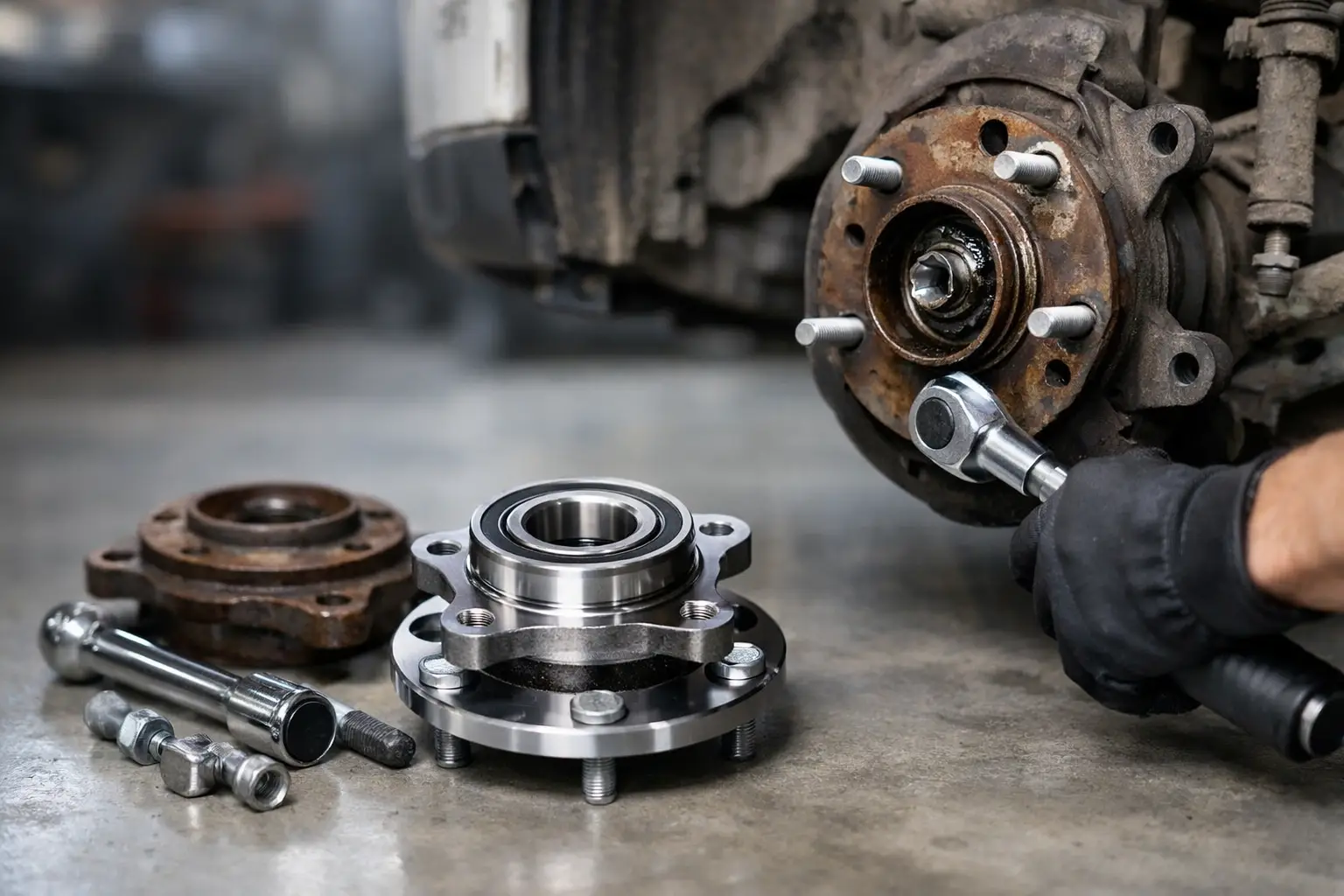
How to Replace Wheel Hub Bearings
A growling noise that gets louder with speed is often your first warning. If the sound changes when turning, or you feel play at the wheel, it may be time to learn how to replace wheel hub bearings before the problem turns into uneven tire wear, poor handling, or a safety risk.
Wheel hub bearings do a hard job. They support vehicle weight, allow the wheel to rotate smoothly, and deal with heat, water, dirt, and constant road shock. When a bearing starts to fail, the fix is usually straightforward in principle, but the exact process depends on the vehicle design. Some cars use a complete hub assembly that bolts on as one unit. Others use a press-in bearing that requires more equipment and tighter installation control.
Not every humming or grinding sound comes from the hub bearing. Tire noise, brake drag, and worn CV joints can sound similar. A quick road test helps. If the noise increases with speed and gets louder when weight shifts to one side during a turn, the bearing on the opposite side is often the problem.
Once the vehicle is raised safely, grab the tire at the 12 and 6 o'clock positions and check for looseness. Spin the wheel by hand and listen for roughness. If the wheel feels gritty, has visible wobble, or shows excessive play, the bearing or hub assembly is a likely cause. On some vehicles, a bad bearing may also trigger an ABS warning light if the wheel speed signal is affected.
This diagnostic step matters. Replacing the wrong side wastes labor, and replacing a good hub will not solve the noise.
For a bolt-on hub assembly, the job is within reach for many experienced DIYers and most workshops with standard service tools. You will typically need a jack and stands, lug wrench, socket set, breaker bar, torque wrench, screwdrivers, pliers, brake service tools, and penetrating oil. An axle socket may also be required on driven wheels.
For press-in bearings, the job is more demanding. You may need a hydraulic press, bearing drifts, snap ring pliers, and model-specific adapters. This is where installation errors happen most often. Pressing on the wrong race can damage a new bearing before the car even leaves the shop.
Part selection is just as important as the tool list. Always match the bearing or hub assembly to the exact vehicle application, including engine variant, drivetrain, and ABS configuration. Precise fitment saves time and reduces comebacks.
Start on a level surface and secure the vehicle properly. Loosen the lug nuts before lifting the car, then raise and support it with jack stands. Remove the wheel and inspect the brake area for obvious leaks, damaged dust shields, or heat marks.
Next, remove the brake caliper and bracket as required, then take off the brake rotor. Do not let the caliper hang by the brake hose. Support it with a hook or wire. If the vehicle uses a driven hub, remove the axle nut. This fastener is often very tight and may be staked, so check the service method before removal.
With the brake components out of the way, locate the hub mounting bolts from the back of the steering knuckle. Disconnect the ABS sensor connector if it is integrated into the hub assembly. Apply penetrating oil around the hub flange if corrosion is present. In real-world workshop conditions, rust is often the hardest part of the job, not the bolts themselves.
Remove the hub bolts and work the old hub assembly free. Some hubs slide out easily. Others seize into the knuckle and need careful persuasion with a hammer or puller. Avoid striking the knuckle excessively, especially on aluminum components.
Before fitting the new part, clean the mounting surface thoroughly. Rust, scale, or dirt between the hub and knuckle can cause misalignment and premature wear. Compare the new hub to the old one, checking bolt pattern, sensor position, flange depth, and connector style.
Install the new hub assembly squarely, then tighten the mounting bolts to the vehicle manufacturer's torque specification. Reinstall the axle nut if required and torque it correctly. This step is critical. Too loose or too tight can shorten bearing life. Refit the rotor, caliper bracket, and caliper, then reconnect the ABS wiring and make sure the harness is routed correctly.
Once the wheel is back on, torque the lug nuts in the proper sequence. Lower the vehicle, pump the brake pedal to restore pedal feel, and carry out a short test drive to confirm the noise is gone.
Press-in bearings take more time and more care. The basic removal steps are similar at first. Lift and support the vehicle, remove the wheel, then remove the brake components. On many front-wheel-drive vehicles, you will also remove the axle nut and separate suspension or steering joints to take the steering knuckle off the car.
Once the knuckle is removed, the hub is pressed out first. In many cases, the inner bearing race stays stuck on the hub and must be removed separately. Then the bearing retaining ring is removed, and the old bearing is pressed out of the knuckle.
This is the stage where technique matters most. The new bearing must be pressed in using the correct support points. Pressure should only be applied to the outer race when installing into the knuckle, and only to the inner race when installing the hub into the bearing. If force travels through the balls or rollers, the new bearing can be damaged internally.
Many modern bearings also have a magnetic encoder ring for the ABS system on one side. Install it backward and the ABS warning light may stay on, even if the bearing itself feels fine. Always check orientation before pressing the part into place.
After the new bearing is installed and the snap ring is refitted, press the hub back in carefully. Reinstall the knuckle, reconnect the suspension components, torque all fasteners to spec, and complete the brake and wheel installation. On some vehicles, an alignment check is a smart next step if major suspension fasteners were removed.
The most common failure points are not always in the part itself. They are often in the installation. Reusing a one-time-use axle nut, skipping torque specs, contaminating the bearing during installation, or hammering directly on the hub can all lead to early noise and repeat repairs.
Poor fitment confirmation is another problem. A bearing that is close but not exact can create ABS faults, seal issues, or mounting stress. For workshops and parts retailers, this is where dependable catalog accuracy and quality-controlled replacement parts make a difference. Good parts reduce guesswork and help avoid unnecessary labor.
It is also worth checking related components while the area is apart. A worn ball joint, damaged CV axle, warped rotor, or torn dust seal can affect how the repair performs over time.
If your vehicle uses a bolt-on hub assembly and you have the right tools, replacing it can be a realistic DIY repair. It still requires safe lifting practices, correct torque, and care around brake and ABS components, but it is generally manageable.
If the vehicle uses a press-in bearing, the answer is usually different. Without a proper press and the correct adapters, the risk of damaging the new part is high. For that reason, many owners choose a professional workshop for press-fit bearing jobs. That is not about making the repair sound complicated. It is about protecting the part, the labor, and the safety of the vehicle.
For workshops, bearing replacement is also a job where part quality shows up quickly. A well-made hub or bearing with accurate dimensions, reliable sealing, and OE-standard testing helps reduce noise complaints and repeat visits. That is one reason many in the aftermarket prioritize consistent, quality-controlled components from established suppliers such as Saiko.
After any hub bearing replacement, listen carefully on the road test. The vehicle should roll quietly, with no grinding, humming, or ABS warning lights. Make sure the steering feels stable and the brakes operate normally.
It is also good practice to recheck for leaks, loose wiring, and proper fastener seating after the test drive. A clean repair is not just about replacing the failed part. It is about making sure the entire corner of the vehicle is back to safe, reliable condition.
A wheel hub bearing is a small component with a big effect on comfort, control, and safety. If you take the time to diagnose the issue properly, use the correct replacement part, and install it with care, the repair will usually reward you with quiet running and confident driving.
Recent Posts
Automotive Trade Is on the Table in the Malaysia-EU FTA. Here's Why It Matters at the Parts Counter
23 Oct 2026
The Road Transport Act Just Got Tougher. Here's What It Means for Your Car's Parts
21 Oct 2026
Drove Through Flood Water? The Parts Under Your Car That Need a Look Next
19 Oct 2026
A Record Year on the Road Means a Record Year Ahead for Maintenance
12 Oct 2026
Budget 2027 Puts E-Hailing Car Maintenance on the National Agenda
12 Oct 2026
 Whatsapp Us NowSaiko Automotive

