


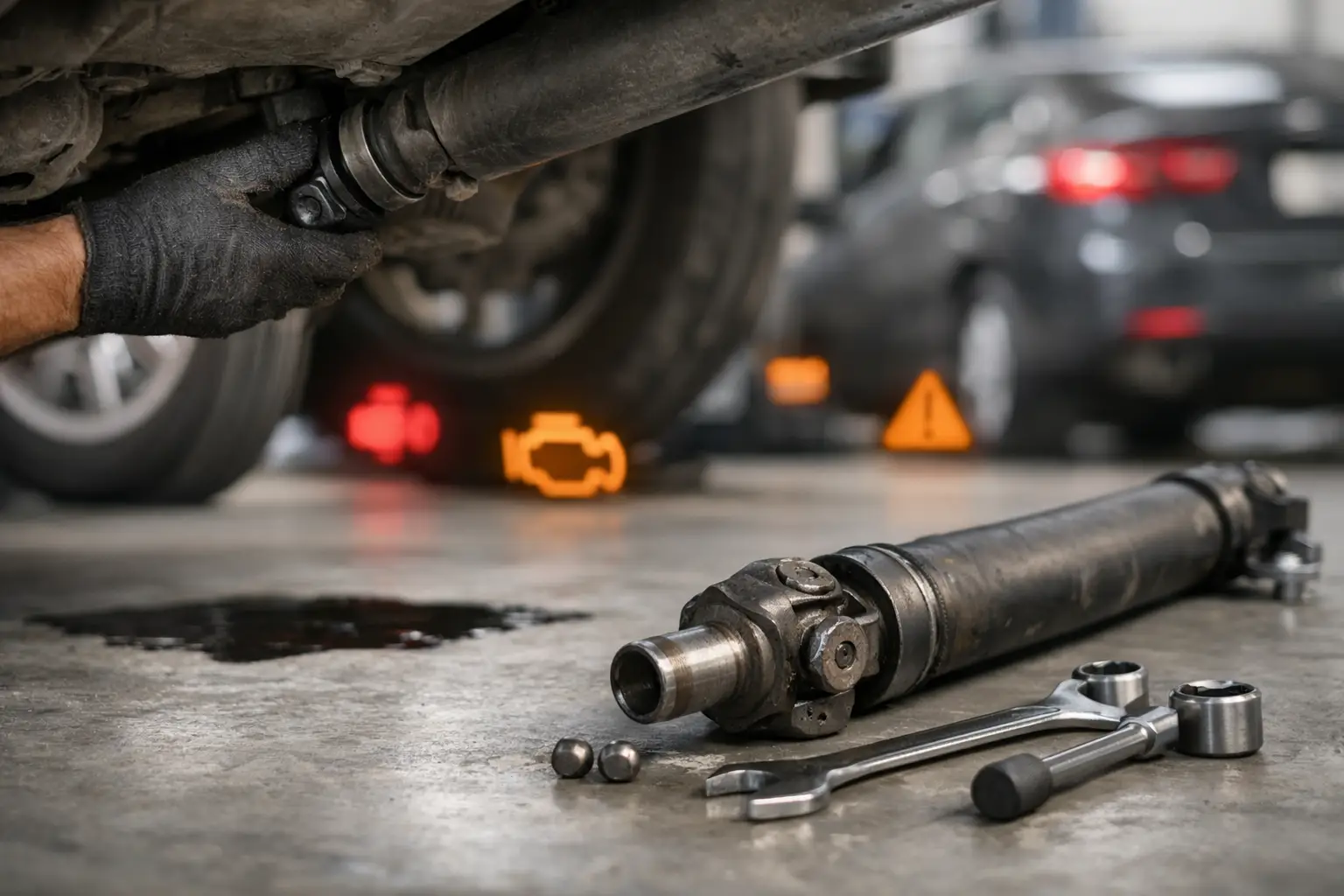
7 Drive Shaft Replacement Symptoms to Watch
A customer says the car only vibrates when accelerating, but feels smoother when cruising. That detail matters. In many cases, drive shaft replacement symptoms start small and feel easy to ignore, especially when the vehicle still moves normally. The risk is that a worn drive shaft rarely fixes itself. It usually gets noisier, rougher, and more expensive if the problem is left too long.
The drive shaft transfers power from the transmission to the wheels. In front-wheel drive and many all-wheel drive passenger vehicles, it works alongside CV joints and boots to keep power delivery smooth while the suspension moves and the wheels turn. When the shaft assembly begins to wear, the symptoms often show up as vibration, clicking, clunking, or a change in how the vehicle responds under load.
Most drivers do not describe the issue as a drive shaft problem at first. They usually report a steering shake, floor vibration, knocking sound, or a harsh feeling during takeoff. Workshops hear these complaints every day, and the challenge is separating a real drive shaft fault from wheel bearing, engine mount, tire, or suspension issues.
One of the clearest signs is vibration during acceleration. If the vibration increases as torque loads the drivetrain, then eases off when the throttle is reduced, the drive shaft assembly becomes a strong suspect. This is especially true when the vibration is felt through the floor pan or lower body rather than only through the steering wheel.
Clicking while turning is another common symptom. A worn outer CV joint often makes a rhythmic clicking or snapping noise during low-speed turns, particularly when pulling out of a parking space. If the sound gets louder over time, the joint wear is already advanced.
Clunking during gear changes or when shifting from reverse to drive can also point to excess play in the shaft or joint. Not every clunk comes from the drive shaft, but repeated impact-like noise under changing load should never be dismissed.
This is often the symptom that gets the vehicle into the workshop. A damaged or worn drive shaft can lose balance or develop internal joint wear, creating vibration that becomes obvious when power is applied. At higher speeds, it may feel like a humming or shudder through the cabin.
If the vibration appears only under acceleration, the cause is often drivetrain-related rather than tire-related. That said, a proper inspection still matters because similar complaints can come from bent wheels, poor tire condition, or worn mounts.
A clicking sound on full-lock turns is a classic CV joint warning sign. The outer joint works hardest when the wheels are turned, so it tends to announce wear early. Once the clicking starts, replacement is usually more practical than trying to extend the part's life.
A torn CV boot often shows up before major joint failure. If grease is splattered around the inner wheel, suspension arm, or nearby underbody area, the boot may have cracked or split. Once grease escapes and dirt enters, joint wear speeds up quickly.
This is one of the easiest symptoms to spot during routine service. Catching it early can prevent a roadside breakdown and secondary damage.
When there is excessive play in the drive shaft joint, the vehicle may produce a clunk as torque is first applied. Drivers often notice it when moving off from a stop, switching between reverse and drive, or lifting on and off the throttle at low speed.
A clunk does not always mean the shaft is finished. Sometimes the issue is elsewhere in the drivetrain. But if the noise is paired with vibration or visible boot damage, replacement becomes much more likely.
A vehicle that shudders while climbing, overtaking, or accelerating uphill may have a worn inner joint. Inner joint wear often feels different from outer joint noise. Instead of clicking on turns, it can create a deeper, harsher shudder during straight-line acceleration.
This matters because some drivers assume the engine is misfiring. If the engine runs smoothly at idle and the shudder appears mainly under drivetrain load, the shaft should be inspected.
A bent shaft, damaged joint housing, or looseness discovered during inspection is a direct warning sign. Physical damage can come from road debris, impact, poor previous installation, or long-term wear. Once the assembly has excessive movement, smooth power transfer is no longer guaranteed.
For workshops, this is where fitment quality also matters. A replacement drive shaft needs accurate dimensions, proper spline fit, and consistent build quality to avoid repeat issues after installation.
As wear becomes more advanced, the sound may change from a light click to a heavier knocking or rotational thump. This can be hard to isolate because it may overlap with wheel hub or bearing noise. The difference is that a failing drive shaft often changes behavior with load, steering angle, or acceleration input.
Drive shaft problems usually progress, not stabilize. A torn boot leads to grease loss. Grease loss leads to contamination. Contamination leads to joint wear, noise, and eventually loss of smooth power delivery. If the condition worsens far enough, the vehicle may become unsafe to drive.
For car owners, that means more than discomfort. It can mean damage to related drivetrain parts and a repair bill that grows because a small fault was allowed to continue. For workshops, delayed replacement can also turn a straightforward job into a more complicated one with seized hardware, damaged surrounding components, or a dissatisfied customer who came in too late.
Wear and age are the most common reasons, especially on higher-mileage vehicles. Rubber boots harden and crack over time. Once the boot fails, the joint is exposed to water, grit, and heat. Even a good-quality joint will struggle if lubrication is lost.
Driving conditions also play a part. Rough roads, repeated heavy loads, pothole impacts, and aggressive turning under power can all shorten service life. In markets where vehicles are used hard every day, reliability depends heavily on both installation quality and part quality.
There is also the fitment factor. A poor-quality shaft assembly may install, but if tolerances are off or materials are inconsistent, vibration, premature wear, or seal issues can appear sooner than expected. That is why workshops and dealers usually prefer parts that are quality-controlled and tested to OE-standard expectations.
A proper diagnosis starts with the complaint. When does the noise happen? Turning, accelerating, reversing, cruising, or braking? That pattern tells a lot. The vehicle then needs a road test and visual inspection, with close attention paid to the boots, grease leakage, shaft play, and joint condition.
Technicians will also rule out other causes. Tire defects, worn engine mounts, wheel bearings, ball joints, and suspension problems can create similar symptoms. This is where experience matters. Replacing the wrong part wastes time for the workshop and money for the customer.
If the CV joint is already noisy, the shaft is vibrating, or the boot failure has gone on long enough to contaminate the joint, replacement is generally the safer and more economical option. Boot replacement may help only when damage is caught very early and the joint has not yet worn.
For many passenger vehicles, replacing the complete shaft assembly is faster and more reliable than attempting partial repair. It reduces downtime, simplifies installation, and lowers the chance of repeat labor. For workshops, that means better efficiency. For drivers, it means getting the vehicle back with more confidence.
This is also why parts selection matters. A dependable aftermarket option should offer stable quality, precise fitment, and coverage across a wide range of vehicle models. Brands with strong quality control and broad application support help workshops complete jobs with fewer surprises.
If your vehicle is showing drive shaft replacement symptoms, the best next step is not to wait for the noise to become obvious to everyone else. Get it checked while the problem is still manageable, because the right repair at the right time protects both the vehicle and the people in it.
Recent Posts
Automotive Trade Is on the Table in the Malaysia-EU FTA. Here's Why It Matters at the Parts Counter
23 Oct 2026
The Road Transport Act Just Got Tougher. Here's What It Means for Your Car's Parts
21 Oct 2026
Drove Through Flood Water? The Parts Under Your Car That Need a Look Next
19 Oct 2026
A Record Year on the Road Means a Record Year Ahead for Maintenance
12 Oct 2026
Budget 2027 Puts E-Hailing Car Maintenance on the National Agenda
12 Oct 2026
 Whatsapp Us NowSaiko Automotive

