


.png "Image")
Isuzu's 1,756km One-Tank Run and the Suspension Secret Behind Fuel Efficiency
Isuzu Malaysia's "D-Max One Tank. One Nation Challenge" made headlines on August 28, 2026, when two units of the 2026 D-Max 2.2, powered by the RZ4F-TC turbodiesel engine, completed a full counter-clockwise loop of Peninsular Malaysia — 1,756 km — on a single tank of diesel, arriving with roughly 4% fuel still in reserve. It's an impressive demonstration for a pickup truck, a vehicle segment not typically associated with fuel-sipping efficiency, and it's a genuinely useful prompt for a question most Malaysian drivers never ask: how much of everyday fuel efficiency actually comes down to wheel alignment and suspension condition, rather than driving style alone?
Feats like this are usually built on careful driving discipline — steady throttle, anticipatory braking, sensible speeds, minimal idling. All of that matters, and none of it should be dismissed. But driving technique is only one half of the fuel efficiency equation. The other half is mechanical: how much resistance the vehicle itself is fighting before the driver even touches the accelerator. A vehicle prepared for a challenge like this is, almost by definition, in excellent mechanical condition — properly aligned, running true, with no component quietly working against the engine's effort. That's the part of the story that rarely makes the headline, but matters just as much for an ordinary commuter as it does for a record attempt.
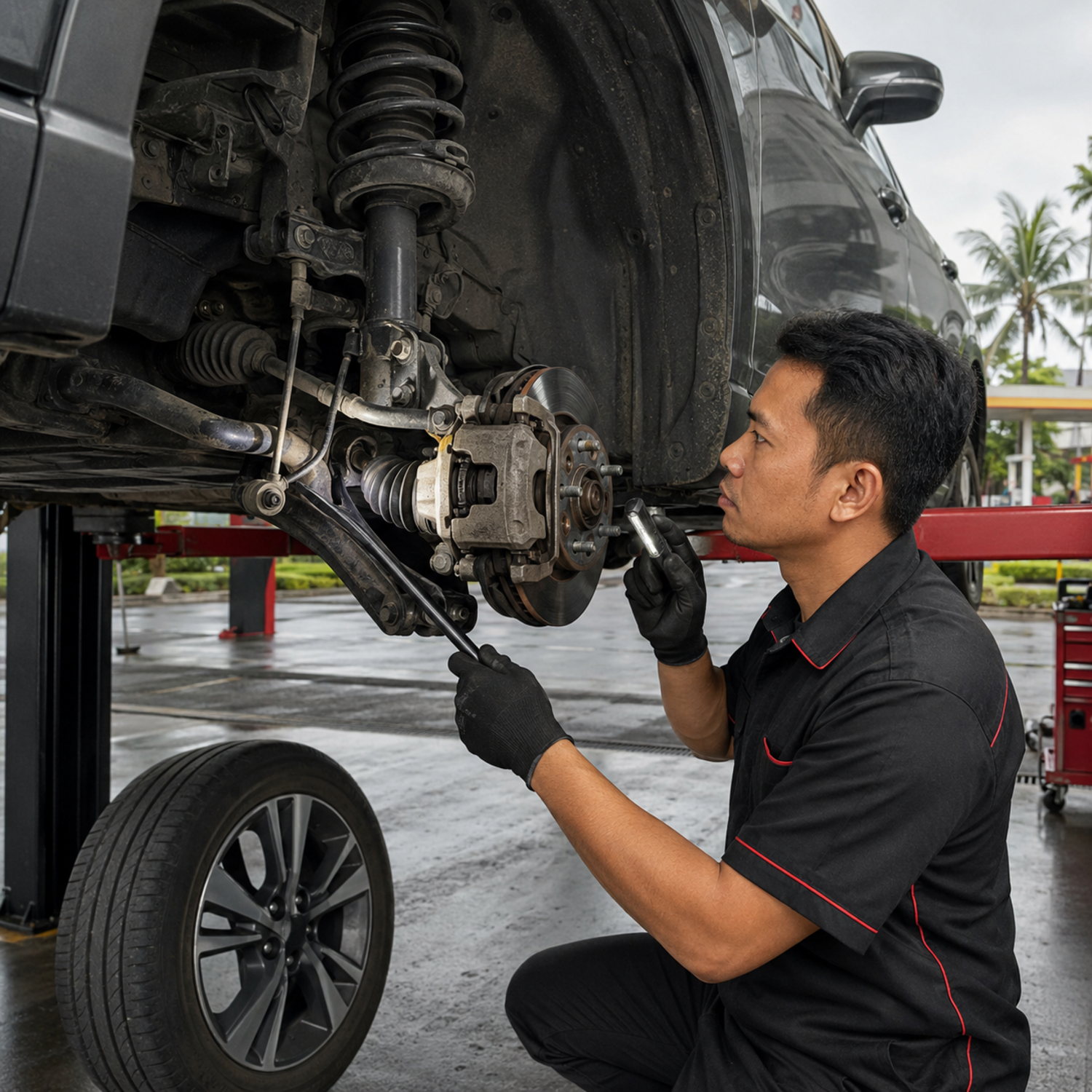
Several components most drivers never think about in relation to fuel consumption are, in fact, directly responsible for how much energy is lost to friction and resistance on every single trip:
None of these show up on a fuel gauge directly. They show up as a slightly higher number at the pump every month, quietly, for as long as the underlying issue goes unaddressed.
A one-off challenge vehicle gets meticulous attention before it rolls out. The average Malaysian daily driver — sedan, SUV, or pickup — usually doesn't get that same scrutiny between services. Over months or years, small amounts of suspension wear accumulate gradually enough that most drivers adjust their driving without noticing the underlying cause, or simply attribute rising fuel costs to traffic, fuel price changes, or age of the vehicle. In reality, a significant portion of that creeping fuel consumption can trace back to alignment drift and suspension wear that a proper inspection would have caught.
It's a reasonable question, and the honest answer is that the effect of any single worn component is usually modest — a percentage point or two, not a dramatic swing. But fuel efficiency losses from misalignment, worn bearings, and tired suspension components tend to stack, not stay isolated. A vehicle with several of these issues at once, which is common once bushings and ball joints have been quietly wearing for tens of thousands of kilometres, can see a meaningfully worse fuel economy figure than the same vehicle properly maintained — without the driver changing a single habit.
A few habits worth adopting, inspired by exactly the kind of preparation that makes a challenge run like Isuzu's possible:
Isuzu's 1,756 km run is a genuinely impressive engineering and driving achievement, and it's a good reminder that fuel efficiency is never just about the engine or the driver's right foot. The suspension and steering system underneath every vehicle is doing constant, invisible work to keep that vehicle running efficiently — or, if neglected, quietly working against it.
SAIKO has supplied quality-controlled automotive replacement parts since 2007, covering more than 400 vehicle models through a nationwide dealer network, with control arms, ball joints, tie rod ends, wheel hub bearings, and shock absorbers built to keep suspension geometry — and fuel efficiency — where it should be.
If it's been a while since your alignment and suspension were checked, that's a simple place to start saving at the pump. Find your nearest SAIKO dealer at saiko.com.my
Recent Posts
Bigger Budi95 Quota, More Mileage: What It Means for Your Car's Suspension
03 Sep 2026
.png "Image")
What China's 4.3 Million Car Recall Teaches Malaysian Drivers About Mechanical Reliability
01 Sep 2026
.png "Image")
Malaysia's Road Maintenance Funding Gap — What It Means for Suspension and Steering Wear
28 Aug 2026
.png "Image")
EPMB's New Tanjong Malim Chassis Facility — What It Signals for Malaysia's Parts Manufacturing Base
26 Aug 2026
.png "Image")
Xpeng X9 Air Suspension Recall: What It Means for Suspension Reliability in Malaysia
24 Aug 2026
 Whatsapp Us NowSaiko Automotive

