


Proton eMas 5's Nepal Debut and What It Says About Malaysia's Automotive Exports
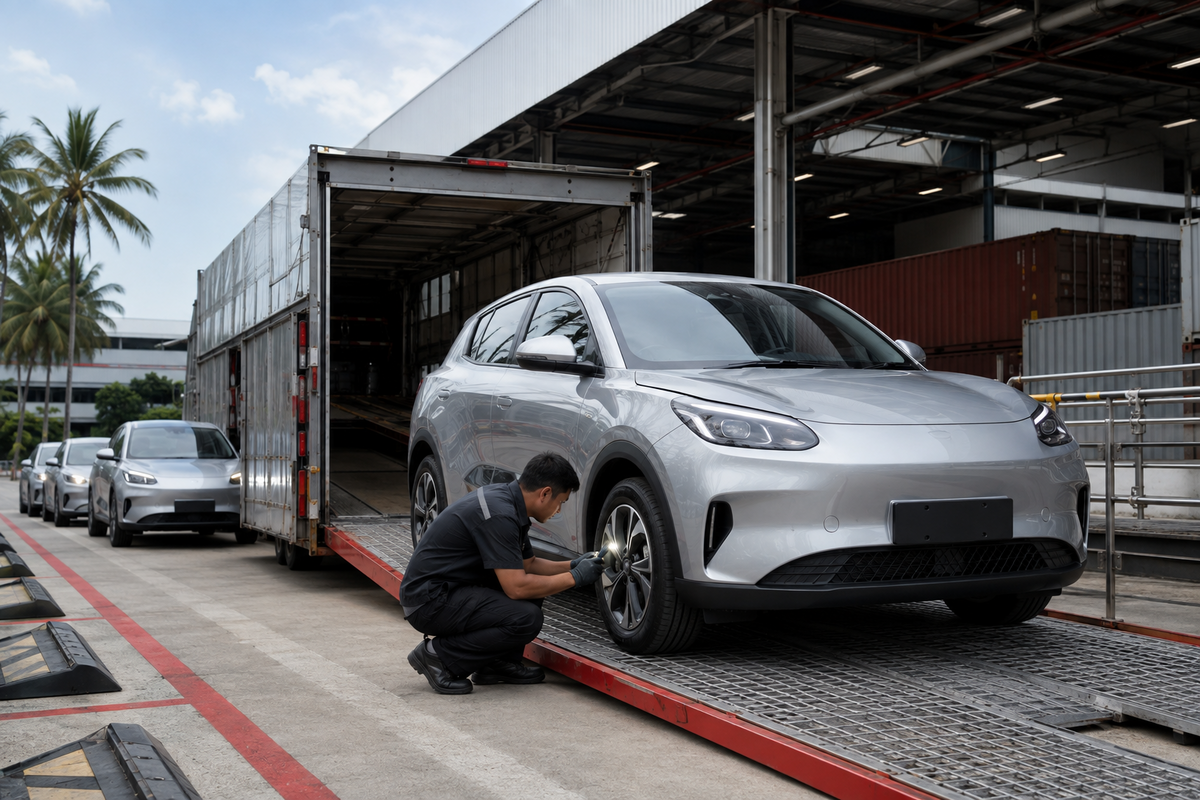
Malaysia's best-selling EV is now selling somewhere else entirely. The Proton eMas 5 launched in Nepal on 3 August, marking the model's second export market after its home debut, with local coverage confirming pricing of roughly 3.5 million Nepalese rupees (about RM94,300) for the Prime variant and 4.0 million rupees (about RM107,770) for the Premium. Buyers get the same two-variant structure familiar from the Malaysian lineup — a Prime with a 49.52 kWh battery good for roughly 345 km of range, and a Premium stepping up to a 60.22 kWh pack and around 410 km. This is a genuine Malaysia automotive export story, not just a new market listing, and it's worth paying attention to for what it signals about where the country's vehicle manufacturing is headed.
One car entering one new market wouldn't normally be a story with much weight behind it. What makes the eMas 5's Nepal launch worth noting is what it represents: a Malaysian-developed and Malaysian-assembled EV proving competitive enough, on cost and specification, to be sold profitably outside its home market. That's a different proposition from importing components or assembling under licence — it means the vehicle, and by extension a meaningful share of its supply chain, has cleared a bar set by a market with no particular loyalty to Malaysian brands.
Export success like this doesn't happen by accident. It requires a component and manufacturing base capable of hitting cost, quality, and volume targets consistently enough to compete on someone else's home turf. Every export unit sold is also a small vote of confidence in the underlying supply chain that built it — the same domestic vendor base, technical capability, and quality standards that Malaysia's National Automotive Policy has been pushing carmakers toward for over a decade.
A growing export business changes incentives at home in ways that are easy to overlook. When a model is being built for both domestic sale and export, the manufacturing standards, quality control, and component sourcing behind it tend to be held to the higher of the two bars, not the lower one. That's good news for Malaysian owners of the same model, whose vehicles benefit from build quality shaped by export-market scrutiny.
It also points to something less obvious but just as important for the aftermarket: as more Malaysian-made EVs reach export markets, the domestic vendor and component base behind them grows in scale and sophistication, whether or not that base is directly supplying the aftermarket parts sold at a workshop counter. A supply chain confident enough to export is one investing in consistency — and that consistency eventually shows up in how predictably a vehicle's components wear, and how well-documented their replacement specifications are.
Not urgently, but it's worth tracking. The eMas 5 is still a relatively new model in the Malaysian car parc, and most of its suspension, steering, and brake components are years away from typical replacement age. What today's export news does is offer an early read on where volume is heading:
Malaysia's automotive story isn't just about which cars sell well at home anymore — it's increasingly about which ones are good enough to sell somewhere else too. That's a meaningful marker of how far the country's manufacturing and component base has come, and it's a trend the parts aftermarket has every reason to plan around rather than react to after the fact.
For distributors serving both retail customers and workshop networks, the practical takeaway is straightforward: models that succeed in export markets tend to be the same models a manufacturer keeps investing in domestically, since shared production lines and shared component sourcing make the two markets mutually reinforcing rather than competing priorities. That gives the aftermarket a genuinely useful early signal — long before a model's first suspension bushing or tie rod end needs replacing, its export performance already hints at how long it will stay in high-volume production, and therefore how much parts demand it will eventually generate.
SAIKO has supplied quality-controlled automotive replacement parts since 2007, with coverage across more than 400 vehicle models through a nationwide dealer network — built to keep pace with an automotive landscape that's growing more sophisticated, both at home and in the export markets it's starting to win.
Explore SAIKO's suspension and steering range and find a dealer near you at saiko.com.my
Recent Posts
.png "Image")
Vehicle Theft in Malaysia: Why Genuine Replacement Parts Matter More Than Ever
07 Sep 2026
.png "Image")
Isuzu's 1,756km One-Tank Run and the Suspension Secret Behind Fuel Efficiency
05 Sep 2026
Bigger Budi95 Quota, More Mileage: What It Means for Your Car's Suspension
03 Sep 2026
.png "Image")
What China's 4.3 Million Car Recall Teaches Malaysian Drivers About Mechanical Reliability
01 Sep 2026
.png "Image")
Malaysia's Road Maintenance Funding Gap — What It Means for Suspension and Steering Wear
28 Aug 2026
 Whatsapp Us NowSaiko Automotive

