


Malaysia's Electrified Vehicles Doubled in a Year — What It Means for Suspension and Steering Parts
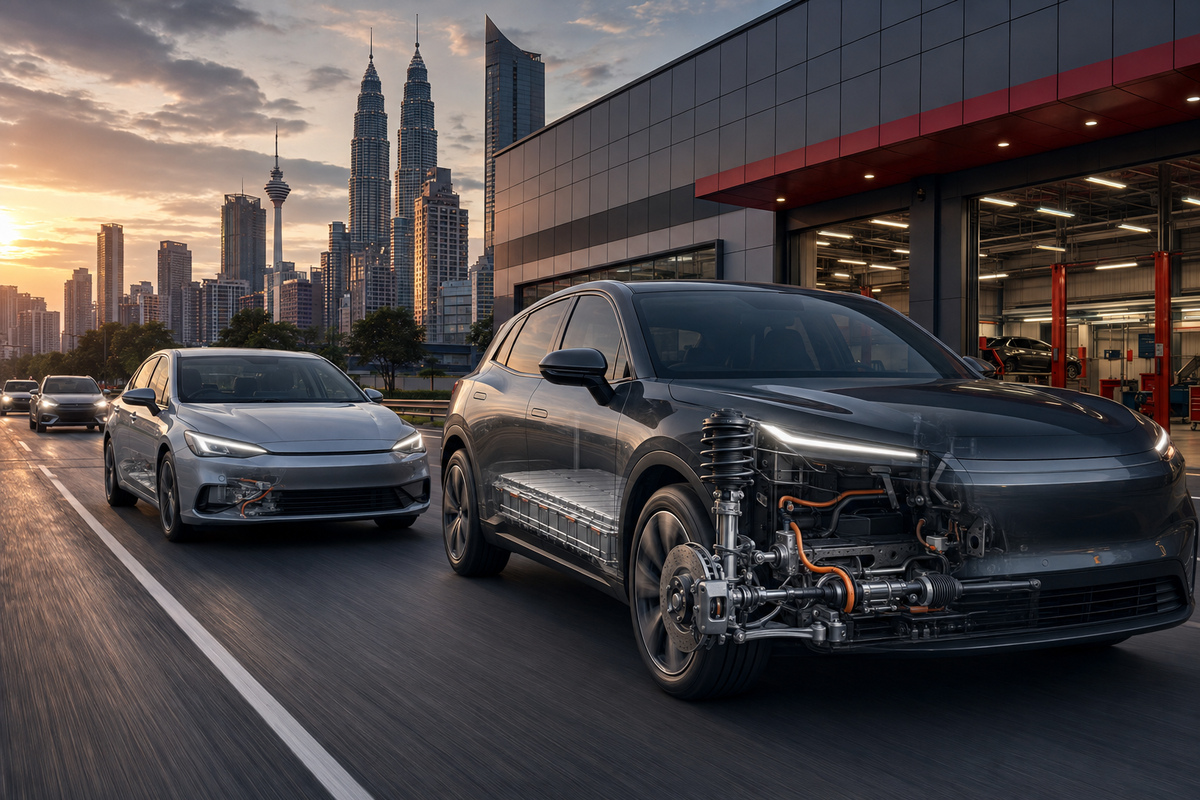
Electrified vehicles Malaysia roads are carrying have reached a milestone that is easy to miss amid the noise of individual model launches. In July 2026, 15.7% of all new vehicles registered in Malaysia were electrified — either a hybrid or a fully electric vehicle — according to JPJ data reported by paultan.org. A year earlier, in July 2025, that figure sat at just 7.0%. In other words, the electrified share of the market has more than doubled in twelve months. Roughly one in every six new cars registered in July had a plug or a hybrid system, up from about one in fourteen a year ago.
For most of 2025, electrified share hovered between 7% and 9%, ticked up to 12.4% during the December EV rush, and has trended steadily higher through 2026, peaking at 16.3% in June before easing slightly to July's 15.7%. Notably, hybrids and EVs have converged rather than one replacing the other: July saw 6,937 EVs and 5,622 hybrids registered, running nearly neck and neck. Petrol still powers the vast majority of Malaysia's market and will for years yet, but the direction of travel is unmistakable.
Do hybrids and EVs really wear out suspension and steering parts differently? Yes — and the reason comes down to physics rather than marketing. Electrified vehicles typically carry more weight than their combustion equivalents, driven by battery packs, electric motors, and reinforced structures. That extra mass has to be supported, absorbed, and controlled by exactly the same suspension and steering components doing the job on a conventional car — just under a heavier, often faster-accelerating load.
A few concrete effects follow from this:
None of this means electrified vehicles are less reliable. It means the suspension and steering system carries a larger share of the total maintenance story than it did when engine service items dominated the conversation.
Where should technicians focus attention as electrified vehicles become mainstream? As the electrified share of Malaysia's vehicle parc keeps climbing, workshops that primarily reference conventional service intervals may find themselves under-checking the chassis side of these vehicles. A few practical points worth building into inspection routines:
This is precisely where component technology, not just component category, starts to matter. SAIKO's ball joints use POM (polyoxymethylene) bearing technology in place of conventional metal-to-metal contact — a lower-friction, self-lubricating, sealed design that resists wear better under sustained load than traditional metal bushings, which require frequent greasing and wear faster under the kind of stress heavier, torque-rich vehicles generate.
That durability difference has been measured directly. In a 7.0 kN stress survival test, a comparable aftermarket part failed at 50,000 cycles and an OEM-equivalent part failed at 100,000 cycles. The SAIKO part reached 247,274 cycles with no damage — up to twice the life of an OEM part and up to four times the life of the tested competitor. For vehicles carrying extra battery weight and generating sharper load transfer, that margin is not a marginal benefit; it is the difference between a component that keeps pace with a demanding duty cycle and one that does not.
Is this trend likely to continue? At the current rate of change, the day when one in five new cars in Malaysia is electrified no longer looks far off. That shift will keep redrawing which components see the most demand and how quickly they wear, and it rewards distributors and workshops that plan ahead rather than react once the parc has already shifted underneath them.
Electrified vehicles are not simply "lower-maintenance cars." They are cars whose maintenance profile has moved — away from the engine bay and toward the chassis. Suspension, steering, and wheel-end components carry more of the burden of keeping these heavier, faster vehicles planted, controlled, and safe to drive.
SAIKO has supplied quality-controlled automotive replacement parts since 2007, covering more than 400 vehicle models through a nationwide dealer network — engineered to handle the loads that Malaysia's fast-electrifying vehicle parc is placing on suspension and steering systems today. Explore SAIKO's full chassis component range at saiko.com.my
Recent Posts
.png "Image")
Vehicle Theft in Malaysia: Why Genuine Replacement Parts Matter More Than Ever
07 Sep 2026
.png "Image")
Isuzu's 1,756km One-Tank Run and the Suspension Secret Behind Fuel Efficiency
05 Sep 2026
Bigger Budi95 Quota, More Mileage: What It Means for Your Car's Suspension
03 Sep 2026
.png "Image")
What China's 4.3 Million Car Recall Teaches Malaysian Drivers About Mechanical Reliability
01 Sep 2026
.png "Image")
Malaysia's Road Maintenance Funding Gap — What It Means for Suspension and Steering Wear
28 Aug 2026
 Whatsapp Us NowSaiko Automotive

