


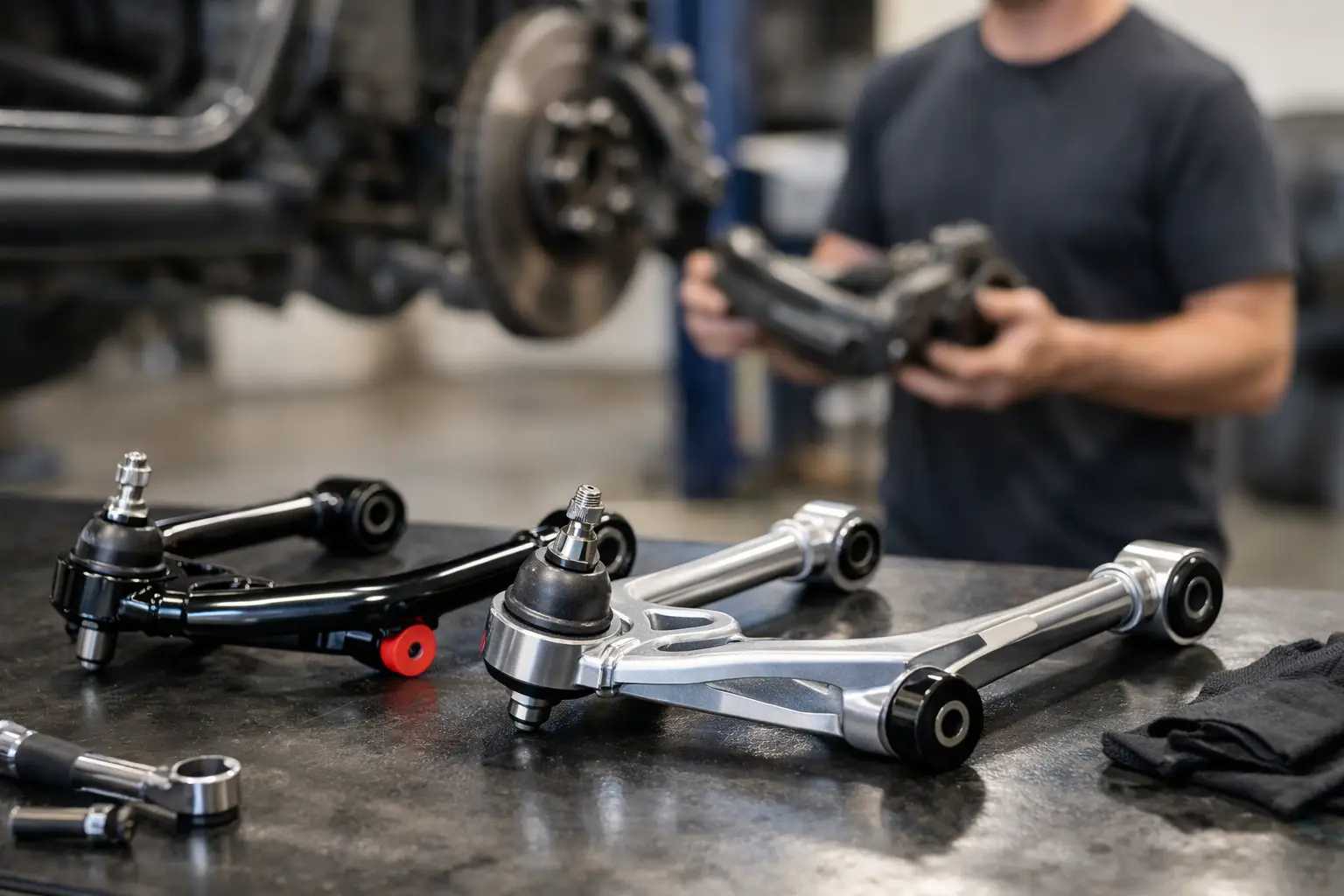
How to Choose Aftermarket Control Arms
A control arm can look simple on the shelf and still cause expensive problems once it is on the car. Poor fitment, weak bushings, thin steel, or inconsistent ball joint quality often show up later as tire wear, steering looseness, noise, or repeat labor. If you are researching how to choose aftermarket control arms, the right approach is not chasing the cheapest option. It is checking fit, construction, durability, and supplier support before the part ever reaches the workshop.
For workshops, retailers, and drivers, control arms sit in the category of parts that affect both ride quality and safety. They help locate the wheel, manage suspension movement, and keep steering geometry stable under braking, cornering, and rough road impact. In real-world conditions, especially where potholes, speed bumps, heavy rain, and stop-and-go traffic are common, control arm quality matters more than many buyers expect.
An aftermarket control arm is not just a metal arm with a bushing at one end and a ball joint at the other. It is a complete suspension component that has to work under load, absorb vibration, and maintain alignment angles within a narrow range. When tolerances are off, even slightly, the driver may feel pulling, clunking, vibration, or unstable handling. The workshop may also face installation delays or alignment issues.
That is why the best buying decision is usually the one that reduces risk after installation. A lower-priced arm may save money at the counter but cost more if the bushing cracks early, the ball joint develops play, or the mounting points do not line up correctly. Good value comes from dependable service life, consistent fitment, and fewer comebacks.
The first check is always vehicle compatibility. This sounds obvious, but many fitment mistakes happen because buyers match the part to a general model name instead of the exact year, engine, drivetrain, body type, or market specification. Some vehicles also use different left and right designs, or different arm shapes across trim levels.
For workshops and retailers, accurate cataloging is critical. A reliable supplier should offer broad vehicle coverage with clear fitment data, especially for Japanese, Korean, Malaysian, and other passenger vehicles that are common on local roads. This is one reason established aftermarket brands with consistent catalog support are easier to work with than unverified parts from uncertain sources.
If the old part is available for inspection, compare the overall shape, mounting points, bushing orientation, stud size, and ball joint position. Even when two parts look similar, a small difference in geometry can affect alignment and suspension travel.
Some control arms come as a full assembly with bushings and a ball joint already installed. Others are sold as a bare arm. For many workshops, a complete assembly is the practical choice because it reduces installation time and removes the uncertainty of pressing in separate components.
Still, it depends on the vehicle and the repair plan. If the arm itself is sound and only the bushing or ball joint is worn, replacing individual pieces may look cheaper. But if labor, pressing equipment, and the risk of damaging the arm are considered, a complete assembly often offers better overall value.
Material quality is one of the clearest differences between a dependable aftermarket control arm and a part that will not last. Stamped steel arms should have consistent thickness, clean welds where applicable, and solid corrosion protection. Cast or forged designs should show good finishing and uniform construction without rough defects or signs of poor machining.
Bushings deserve close attention because they absorb road shock and isolate noise and vibration. Low-quality rubber may feel acceptable at first but harden, crack, or separate early. That leads to clunking, excess movement, and unstable braking feel. A quality bushing should be made to handle repeated load cycles and normal heat, oil exposure, and road contamination.
The ball joint is just as important. If it is integrated into the control arm, it needs proper sealing, durable internal materials, and tight manufacturing tolerances. A loose or poorly protected ball joint can create steering play quickly. On a daily-driven passenger vehicle, this is not a small comfort issue. It directly affects control and tire wear.
A clean paint finish or shiny metal can make a part look premium, but appearance alone does not prove durability. Buyers should focus more on fitment accuracy, bushing quality, and tested consistency than cosmetic presentation. Many low-cost parts look acceptable out of the box and fail where it actually counts.
Price matters, especially for retailers managing stock and workshops trying to offer customers realistic repair options. But the lowest part cost is not always the lowest repair cost. If a control arm fails early, the customer pays for another alignment, more labor, and more downtime. The workshop may lose trust. The retailer may face returns and complaints.
A better way to compare options is to ask what the buyer is getting for the money. Is the fitment precise? Are the bushings and ball joints included? Is the part quality-controlled and tested to OE-standard expectations? Is stock readily available when the vehicle comes in for service? Does the supplier support a wide range of applications so retailers and dealers can source consistently from one brand?
For that reason, established aftermarket suppliers often make more sense than unbranded or inconsistent imports. A dependable brand such as SAIKO, which has supplied quality-controlled suspension and steering parts across a broad range of passenger vehicles since 2007, gives workshops and retailers more confidence in availability, fitment, and repeatability.
Some warning signs are easy to spot before installation. Packaging that lacks basic part identification, missing fitment details, poor finishing around bushing housings, rough machining, or weak corrosion coating should raise concern. If the supplier cannot clearly confirm compatibility, that is another red flag.
There are also practical business signals. If the part source changes often, warranty support is unclear, or the same item number arrives with different construction each time, consistency is already a problem. Workshops need predictable parts. Retailers need products they can recommend without hesitation. Car owners need repairs that last beyond the next few months.
Even the right part can underperform if it is installed carelessly. Control arm mounting bolts often need to be tightened at the correct ride height to avoid preloading the bushings. Ball joint fasteners need proper torque. Once the part is installed, alignment should be checked whenever the suspension geometry may have changed.
This is why workshops often prefer brands with precise fitment. A well-made arm saves time during installation and reduces the chance of forcing components into place. When holes line up properly and dimensions match the original design, the repair process is smoother and the final result is more reliable.
For a normal passenger car used for commuting, family transport, or city driving, the best choice is usually not the stiffest or most performance-focused arm. It is the one that restores factory-like handling, quiet operation, and stable braking with dependable service life. In other words, choose for intended use.
If the vehicle regularly carries heavy loads, sees rough roads, or has a history of suspension wear, durability becomes even more important. In those cases, buyers should pay extra attention to bushing strength, corrosion resistance, and the supplier's quality control. A slightly higher upfront cost can make sense if it prevents repeat work.
For modified vehicles, the answer can be different. Some owners want sharper handling or adjustable suspension geometry. That is a separate buying decision and should not be confused with standard replacement needs. For most drivers, a control arm that matches OE fit and function is the safer and more practical choice.
Before stocking or installing control arms, ask direct questions. Is the part supplied as a complete assembly? What vehicle applications does it cover? Is quality consistent across batches? Are ball joints and bushings tested as part of the full assembly? How stable is supply for fast-moving models?
These questions matter because control arms are not one-time impulse purchases. They are service parts tied to trust. A workshop that uses reliable parts reduces comebacks. A retailer that stocks dependable brands builds repeat business. A driver who gets a stable, quiet, properly aligned car after repair notices the difference right away.
A good control arm should fit correctly the first time, hold alignment, absorb road shock without excessive noise, and deliver value over the long term. That is the standard worth paying for. When you choose with fitment, material quality, complete assembly design, and supplier reliability in mind, the right part usually becomes much easier to identify.
The smartest purchase is rarely the one with the lowest sticker price. It is the one that keeps the car driving straight, the tires wearing evenly, and the customer out of the workshop for the right reasons.
Recent Posts
Drove Through Flood Water? The Parts Under Your Car That Need a Look Next
19 Oct 2026
A Record Year on the Road Means a Record Year Ahead for Maintenance
12 Oct 2026
Budget 2027 Puts E-Hailing Car Maintenance on the National Agenda
12 Oct 2026

A Rear Axle Recall Is a Reminder: The Back of the Car Matters Too
12 Oct 2026
Scrap or Maintain? What a Proposed Old-Car Rebate Means for Malaysia's Older Vehicles
09 Oct 2026
 Whatsapp Us NowSaiko Automotive

