


RM300 Million Inokom Investment Signals Malaysia's Growing Automotive Manufacturing Base
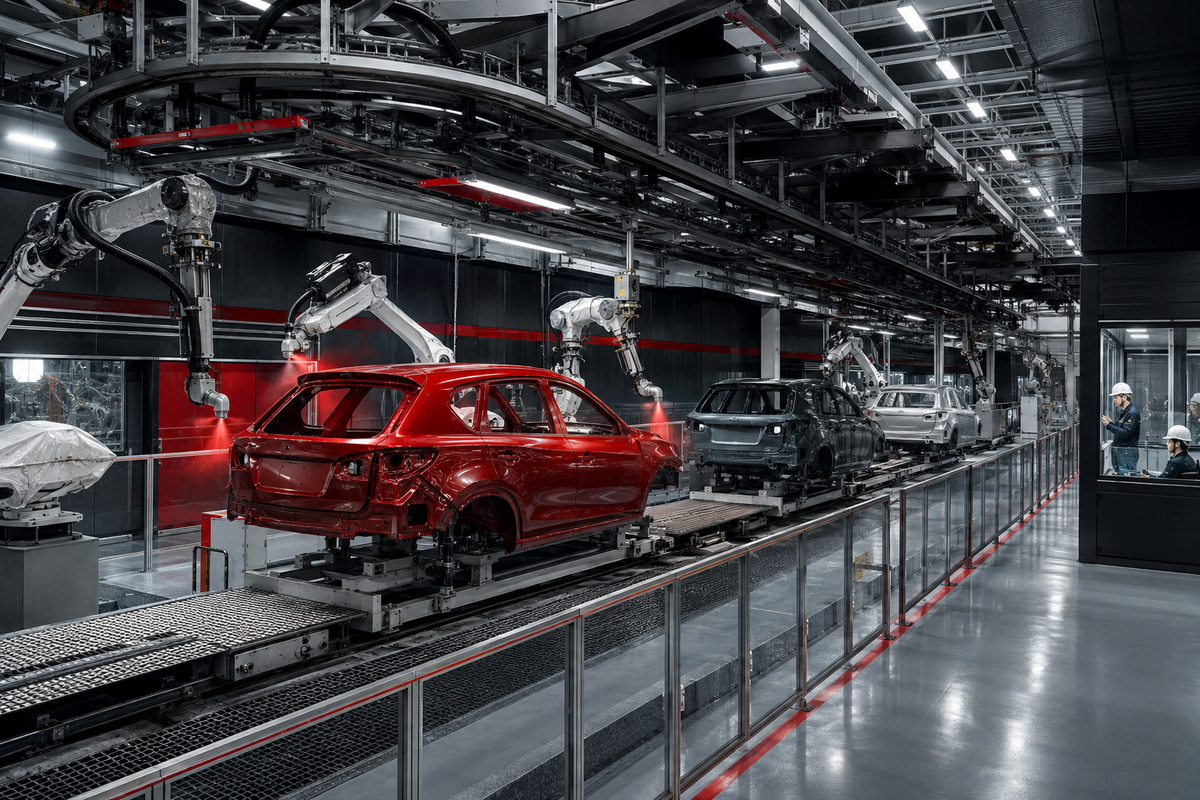
Malaysia automotive manufacturing capacity took a significant step forward this month. Sime Motors has expanded Inokom Corporation's operations with a new painting facility, Paint Shop 3 (PS3), at its 200-acre site in Kulim, Kedah, built with an investment of RM300 million. The facility was officially launched by the minister of investment, trade and industry, Datuk Seri Johari Abdul Ghani, underscoring how seriously the government continues to treat local vehicle manufacturing capacity as a national economic priority.
PS3 adds substantial production capability to Inokom's operations, supporting Mazda's CKD (completely knocked-down) requirements while providing added capacity and flexibility for other CKD customers using the plant. Based on a two-shift operation, the new facility is designed to paint up to 50,000 vehicle bodies a year at a rate of 15 units per hour, with the added capability of plastic parts painting. Combined with Inokom's existing facilities, total paint shop capacity at the Kulim site now stands at 100,000 painted vehicle bodies per annum.
Does a single paint facility upgrade really matter for the wider industry? On its own, a painting line might look like a narrow operational detail. In context, it is a signal of something larger: continued confidence in Malaysia as a manufacturing base for the region, at a time when automakers are making long-term capital commitments rather than short-term production adjustments.
A few details from the facility illustrate the scale of that commitment:
The development also benefited from close collaboration with Mazda's technical support team, giving Inokom's own workforce direct knowledge transfer and training throughout installation and commissioning — an investment in local technical capability that extends well beyond the physical plant itself.
How does a CKD investment like this connect to aftermarket parts? Local assembly capacity and the aftermarket parts ecosystem are more closely linked than they might first appear. A stronger CKD manufacturing base in Malaysia tends to support the wider automotive supply chain in a few practical ways:
A growing manufacturing base and a growing aftermarket are, in this sense, two sides of the same industry. Vehicles assembled locally today become part of the vehicle parc that workshops and parts distributors will be servicing for the next decade and beyond.
Investments like PS3 highlight something that applies just as directly to the aftermarket side of the industry: the value of being genuinely local, not just present in the market. A manufacturing partner with local technical teams, local training pipelines, and local investment tends to respond faster and more reliably than one operating at arm's length from the market it serves — and the same principle holds true for parts distribution and workshop support.
This is a pillar SAIKO has built its own position around. Alongside broad model coverage and OE-grade manufacturing consistency, SAIKO maintains strong local warranty support and an experienced local technical team, so that workshops and distributors get fast, dependable response rather than waiting on support routed through a distant head office. As Malaysia's manufacturing base grows more sophisticated, the expectation for local responsiveness across the entire automotive supply chain — manufacturing and aftermarket alike — only rises with it.
What should the industry take away from this investment? A RM300 million facility expansion, backed by a cabinet minister at its launch and built with an eye toward future flexibility across CKD customers, is a clear vote of confidence in Malaysia's role as a regional automotive manufacturing hub. For an industry watching sales records break and electrified vehicle adoption accelerate in the same year, this kind of manufacturing investment adds another dimension: the vehicles fuelling that growth increasingly have a genuine local production footprint behind them.
For parts distributors, workshops, and everyone else supporting Malaysia's vehicle parc after it leaves the factory gate, that is a reminder that the strength of the local automotive ecosystem — from assembly line to service bay — depends on the same qualities: consistency, technical capability, and a genuine local presence.
SAIKO has supplied quality-controlled automotive replacement parts since 2007, backed by a nationwide dealer network and local technical support built to match the pace of Malaysia's growing automotive industry. Learn more about SAIKO's parts range and dealer network at saiko.com.my
Recent Posts
.png "Image")
Xpeng X9 Air Suspension Recall: What It Means for Suspension Reliability in Malaysia
24 Aug 2026
Malaysia's Electrified Vehicles Doubled in a Year — What It Means for Suspension and Steering Parts
19 Aug 2026
Malaysia Car Sales 2026: What a Record-Pace Year Means for Aftermarket Parts Demand
17 Aug 2026
Proton eMas 5's Nepal Debut and What It Says About Malaysia's Automotive Exports
15 Aug 2026
Malaysia's EV Localisation Push: What It Means for the Parts Aftermarket
14 Aug 2026
 Whatsapp Us NowSaiko Automotive

