


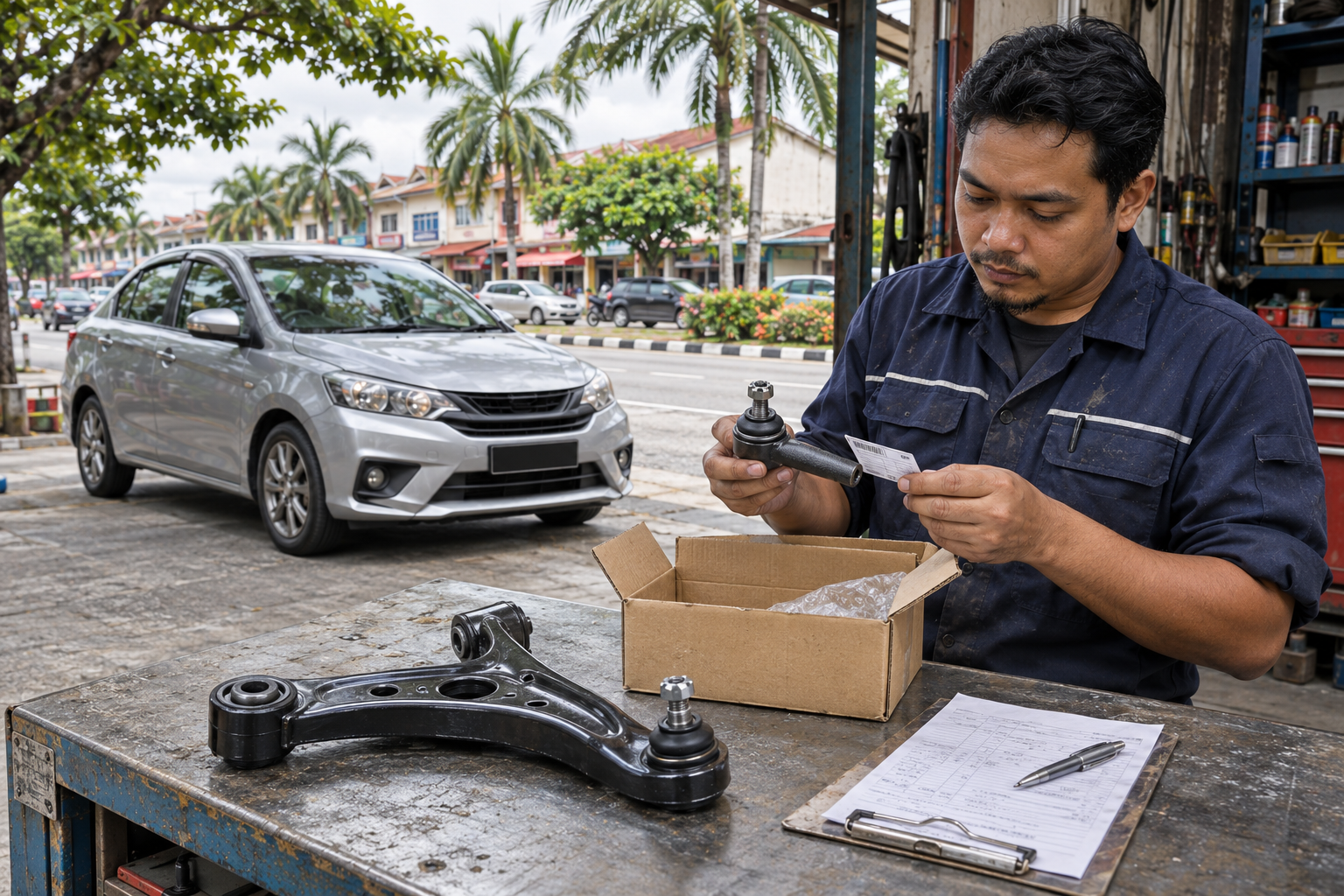
Fake Parts Raid in Ipoh: The Real Cost of Counterfeit Components
The problem of counterfeit car parts in Malaysia surfaced again last week. On 18 November 2026, enforcement officers from the Perak office of the Ministry of Domestic Trade and Cost of Living (KPDN) raided a business premises in the IGB Ipoh Industrial Area and seized 193 units of various heavy vehicle spare parts, all suspected of carrying falsely applied trademarks. According to Ipoh Echo's report of 19 November, the goods were valued at an estimated RM26,165, and the raid followed a complaint and information from a representative of the trademark owner.
Perak KPDN director Datuk Kamalludin Ismail said the inspection "uncovered 193 units of various types of heavy vehicle spare parts, all suspected of bearing trademarks that had been falsely applied to the products." The case is being investigated under Section 100 of the Trademarks Act 2019, with Section 102(1)(c) covering possession of such goods for trade.
On paper, this is a trademark case. On the road, it is a safety story. A part that only looks like the genuine article has never been asked to prove it can do the job, and drivers rarely find out until something gives way.
Counterfeit components survive in the market for one simple reason: at the counter, they look like a bargain. The box carries a familiar logo, the part looks right, and the price is noticeably lower. For a fleet operator watching costs, or a car owner who just wants the noise gone, the temptation is easy to understand.
What the buyer cannot see is everything that matters:
The Ipoh case involved heavy vehicle parts, but the same pattern runs through the passenger car market. Filters, brake components, suspension joints and bearings are all regular targets, because they sell in volume and failures are often blamed on "bad luck" rather than on the part itself.
Not every inferior part fails dramatically. Many simply wear out far sooner than they should, which is a hidden cost of its own. But on safety-critical systems, the stakes are higher.
Consider what steering and suspension components actually do. A tie rod end transmits every steering input to the wheel. A ball joint carries the load of the corner while letting the wheel articulate. A wheel hub bearing supports the wheel's rotation and, on many cars, feeds wheel-speed data to the ABS. When one of these parts is made from the wrong material or assembled without proper sealing, typical outcomes include:
The damage also spreads. A failing joint puts extra stress on neighbouring components, so a "cheap" repair can end up costing more than doing the job properly once. Every component in the chassis is part of one system, and compromising one part compromises the whole.
Enforcement raids help, but they cannot replace careful buying. A few practical habits go a long way:
For workshops, fitting a counterfeit part, even unknowingly, risks a warranty dispute and lost trust. A short list of reliable suppliers is the best protection.
The lesson from Ipoh is not that every lower-priced part is fake. A healthy aftermarket exists precisely because quality replacement parts can offer excellent value compared with dealer pricing. The difference lies in accountability: a brand that controls its quality, documents its testing, and stands behind what it sells.
That is the standard SAIKO works to. SAIKO has supplied quality-controlled automotive replacement parts since 2007, with coverage for more than 400 vehicle models and a nationwide dealer network. Our steering and suspension range is built as one ecosystem, from strut mounts and coil springs to tie rod ends, rack ends, ball joints, stabilizer links and lower arms, designed as direct OE-fit replacements that need no modification.
Durability is something we test rather than assume. In SAIKO's internal 7.0 kN stress survival test, our ball-joint-style parts completed 247,274 cycles without damage, compared with 100,000 cycles for the OEM part and 50,000 cycles for an unnamed aftermarket competitor tested. That puts SAIKO parts at up to 2× longer than OEM and up to 4× longer than competitors in that test. Our ball joints also use POM (polyoxymethylene) bearing technology, which offers low friction, high wear resistance and sealed, maintenance-free operation compared with conventional metal-to-metal contact.
Counterfeit parts will keep appearing as long as buyers cannot tell the difference. The best defence is knowing where your parts come from, asking the right questions, and choosing brands that put their quality on record. Your steering, suspension and brakes deserve nothing less.
Looking for genuine, quality-controlled replacement parts? Find a SAIKO dealer near you at saiko.com.my
Recent Posts
Steering Rack Problems: Signs, Causes and Replacement in Malaysia
21 Nov 2026
Lower Arm vs Upper Arm vs Control Arm: Signs of Wear and When to Replace (Malaysia)
21 Nov 2026
Absorber Kereta: Tanda Rosak, Bocor dan Cara Semak Harga
21 Nov 2026
How to Choose the Best Shock Absorber Brand in Malaysia (2026 Guide)
21 Nov 2026
The Overloading Crackdown: What Extra Weight Does to Your Chassis
20 Nov 2026
 Whatsapp Us NowSaiko Automotive

